
Is Oral Paclitaxel + Encequidar Effective for Breast Cancer?
Is Oral Paclitaxel + Encequidar Effective for Breast Cancer?
Medical Supporter — Information Notice
This article is a summary of international medical information and is not medical advice; it cannot replace the diagnosis or treatment plan of your attending physician. The medical technologies, drug information and clinical data presented here are compiled from public literature and official statements of major Japanese medical institutions; the applicability and outcome of any therapy vary with each patient and must be assessed individually by a qualified physician.
Formerly certified by Japan's Ministry of Foreign Affairs Medical Visa Guarantee Agency B-66 Travel Services Arrangement Business License No. 35, Fukuoka Prefecture, Japan Japanese Medical Equipment Sales and Rental Business Management
Formerly certified by Japan's Ministry of Foreign Affairs Medical Visa Guarantee Agency B-66 Travel Services Arrangement Business License No. 35, Fukuoka Prefecture, Japan Japanese Medical Equipment Sales and Rental Business Management
Is Oral Paclitaxel + Encequidar Effective for Breast Cancer?
On July 20, 2022, Hope S. Rugo and colleagues from the University of California San Francisco published the results of the Phase III clinical trial on the efficacy and safety of oral Paclitaxel + Encequidar in patients with metastatic breast cancer in the medical journal Journal of Clinical Oncology.
This Phase III trial was an open-label study that randomized metastatic breast cancer patients (N = 402) in a 2:1 ratio into two groups: oral Paclitaxel (205mg/m2) + Encequidar (15mg, taken continuously for three days) group (21-day treatment cycles, N = 265) and intravenous Paclitaxel (175mg/m2) group (21-day treatment cycles, N = 137). The primary endpoint was imaging-based response rate, and secondary endpoints were progression-free survival and overall survival.
The trial results showed that the primary endpoint response rates were: oral Paclitaxel + Encequidar group 36% versus intravenous Paclitaxel group 23%.
The secondary endpoints showed that the median progression-free survival was: oral Paclitaxel + Encequidar group 8.4 months versus intravenous Paclitaxel group 7.4 months, and the median overall survival was: oral Paclitaxel + Encequidar group 22.7 months versus intravenous Paclitaxel group 16.5 months.
Regarding safety, the incidence of Grade 3-4 adverse events was: oral Paclitaxel + Encequidar group 55% versus intravenous Paclitaxel group 53%. The incidence of severe neuropathy was: oral Paclitaxel + Encequidar group 2% versus intravenous Paclitaxel group 15%. Hair loss incidence was: oral Paclitaxel + Encequidar group 49% versus intravenous Paclitaxel group 62%. Neutropenia was higher in the oral Paclitaxel + Encequidar group, particularly in patients experiencing nausea, vomiting, diarrhea, and hepatic dysfunction.
Based on the Phase III trial results, Hope S. Rugo and colleagues concluded that metastatic breast cancer patients receiving oral Paclitaxel + Encequidar showed improved progression-free survival and overall survival compared to the intravenous Paclitaxel group, with lower incidence of neuropathy-related adverse events.
Source: https://ascopubs.org/doi/full/10.1200/JCO.21.02953
This website uses cookies to understand how you interact with it. By accepting, you agree to our use of cookies. Privacy Policy
Medical Supporter was formerly certified as an international medical visa guarantor by Japan's Ministry of Foreign Affairs and the Ministry of Economy, Trade and Industry (B-066).
Considering medical care in Japan? Need information and support?
We help you organize the information needed for medical travel to Japan, liaise with Japanese medical institutions, and arrange a second-opinion consultation.The first consultation is free; an advisor will help you clarify the next steps.
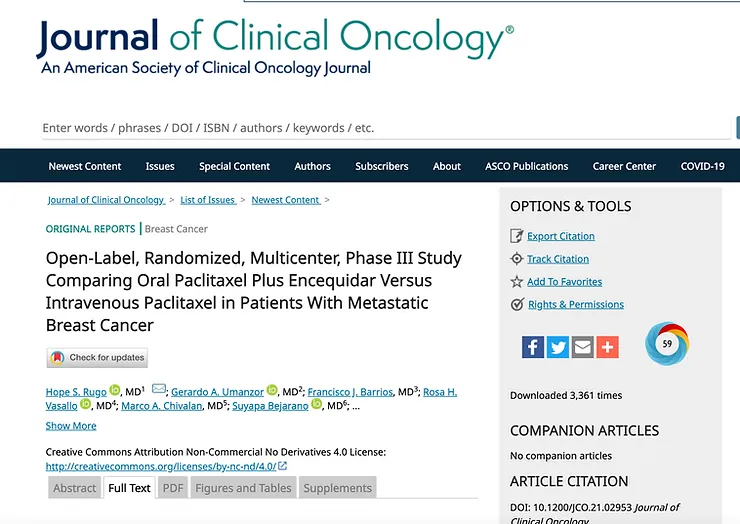 Figure 1
 Figure 2
 Figure 3
 Figure 4