
ALK-Positive NSCLC: Alecensa Phase III Efficacy and Safety Data
Medical Supporter — Information Notice
This article is a summary of international medical information and is not medical advice; it cannot replace the diagnosis or treatment plan of your attending physician. The medical technologies, drug information and clinical data presented here are compiled from public literature and official statements of major Japanese medical institutions; the applicability and outcome of any therapy vary with each patient and must be assessed individually by a qualified physician.
Phase III Trial Results
- February 18, 2016
Chugai Pharmaceutical announced Phase III trial results evaluating alectinib (Alecensa) in untreated ALK-positive non-small cell lung cancer. The trial demonstrated superior efficacy with no safety concerns, leading to early termination.
Clinical Context
Alectinib represents an ALK tyrosine kinase inhibitor developed for ALK-positive NSCLC treatment. Phase III trial results support efficacy and tolerability in first-line ALK-positive disease.
Trial Outcomes
Phase III trial demonstrated:
- Superior clinical efficacy outcomes
- Favorable safety and tolerability profile
- No novel or unexpected adverse events
- Early termination due to positive efficacy signals
Clinical Significance
Alectinib efficacy in Phase III trial validates ALK inhibition as standard first-line approach for ALK-positive NSCLC, with favorable benefit-risk profile supporting regulatory approval and clinical adoption.
Data Source
http://www.chugai-pharm.co.jp/
Medical Supporter was formerly certified as an international medical visa guarantor by Japan's Ministry of Foreign Affairs and the Ministry of Economy, Trade and Industry (B-066).
Considering medical care in Japan? Need information and support?
We help you organize the information needed for medical travel to Japan, liaise with Japanese medical institutions, and arrange a second-opinion consultation.The first consultation is free; an advisor will help you clarify the next steps.
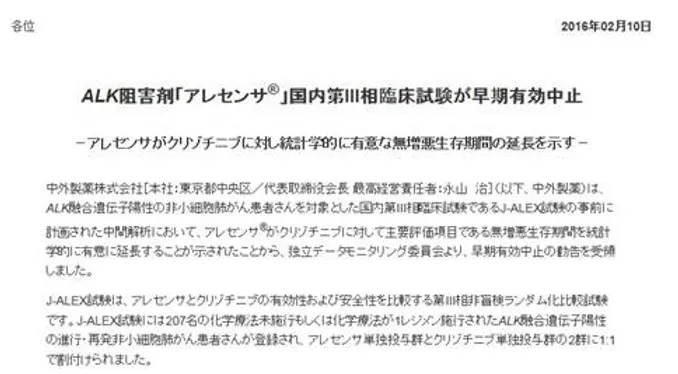 Figure 1
 Figure 2
 Figure 3
 Figure 4