
(Lung Cancer) What Is the Efficacy of Next-Generation TKI Inhibitor Repotrectinib?
Medical Supporter — Information Notice
This article is a summary of international medical information and is not medical advice; it cannot replace the diagnosis or treatment plan of your attending physician. The medical technologies, drug information and clinical data presented here are compiled from public literature and official statements of major Japanese medical institutions; the applicability and outcome of any therapy vary with each patient and must be assessed individually by a qualified physician.
- August 13, 2019
- Reading time: 2 minutes
At ASCO 2019 (May 31–June 4) in Chicago, Byoung-Chul Cho presented the efficacy and safety results of repotrectinib (a next-generation ROS1/TRK/ALK tyrosine kinase inhibitor) monotherapy in ROS1 fusion-positive non-small cell lung cancer (NSCLC) patients from the TRIDENT-1 Phase 1 trial.
Trial Design
This Phase 1 trial enrolled both TKI-naive and TKI-pretreated ROS1/TRK/ALK mutation-positive NSCLC patients receiving repotrectinib monotherapy. Primary endpoint: Safety.
Background: ROS1 fusion gene mutations account for 1–2% of NSCLC patients. The only currently available targeted therapy is crizotinib. Repotrectinib, a next-generation ROS1/TRK/ALK TKI, demonstrates ROS1 inhibition potency up to 90-fold greater than crizotinib. In preclinical studies, repotrectinib showed potent kinase inhibition against ROS1 solvent-front mutations (G2032R) and other ROS1 fusion-positive resistance mutations.
Efficacy Results
TKI-naive ROS1 fusion-positive NSCLC patients:
- ORR: 82% (N=9/11)
- Duration of response: Not reached
- Intracranial response: 100% (N=3/3)
TKI-pretreated ROS1 fusion-positive NSCLC patients:
- ORR: 39% (N=7/18)
- ROS1 G2032R mutation subgroup ORR: 40% (N=2/5)
Safety Profile
Adverse event rates:
- Dizziness: 56.6%
- Dysgeusia: 50.6%
- Dyspnea: 30.1%
- Fatigue: 30.1%
- Constipation: 28.9%
- Paresthesia: 28.9%
- Anemia: 27.7%
- Nausea: 22.9%
- Cough: 20.5%
4 patients experienced dose-limiting toxicities: dizziness (3 patients), dyspnea (1 patient), hypoxia (1 patient).
Conclusions
Based on the TRIDENT-1 trial results, Byoung-Chul Cho concluded that repotrectinib monotherapy in ROS1 fusion-positive NSCLC patients achieved ORRs of 39–82%, and adverse events were manageable.
Source: Safety and preliminary clinical activity of repotrectinib in patients with advanced ROS1 fusion-positive non-small cell lung cancer (TRIDENT-1 study). 2019 ASCO Annual Meeting, Abstract No: 9011.
Tags: #LungCancer
- Clinical trial drug
Medical Supporter was formerly certified as an international medical visa guarantor by Japan's Ministry of Foreign Affairs and the Ministry of Economy, Trade and Industry (B-066).
Considering medical care in Japan? Need information and support?
We help you organize the information needed for medical travel to Japan, liaise with Japanese medical institutions, and arrange a second-opinion consultation.The first consultation is free; an advisor will help you clarify the next steps.
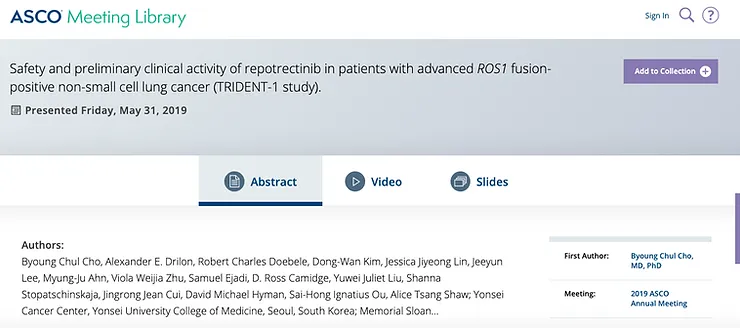 Figure 1
 Figure 2
 Figure 3
 Figure 4