
(Ovarian Cancer) Is Niraparib Monotherapy Effective?
Medical Supporter — Information Notice
This article is a summary of international medical information and is not medical advice; it cannot replace the diagnosis or treatment plan of your attending physician. The medical technologies, drug information and clinical data presented here are compiled from public literature and official statements of major Japanese medical institutions; the applicability and outcome of any therapy vary with each patient and must be assessed individually by a qualified physician.
On December 19, 2019, Antonio González-Martín published in The New England Journal of Medicine the "Efficacy and Safety of PARP Inhibitor Niraparib Monotherapy as Maintenance Therapy in Ovarian Cancer Patients Responding to Platinum-Based Chemotherapy in the PRIMA Phase III Clinical Trial."
The PRIMA Phase III clinical trial randomly assigned ovarian cancer patients responding to platinum-based chemotherapy (N=733) in a 2:1 ratio to either the Niraparib monotherapy group (once daily) or the placebo group (once daily). The primary endpoint was progression-free survival, and the secondary endpoint was overall survival.
This trial was initiated because the established standard treatment for ovarian cancer — surgery and platinum-based chemotherapy — results in recurrence in approximately 85% of patients after treatment ends. Although bevacizumab has been used in recent years as combination and maintenance therapy, its safety and long-term data have not been established. Based on this background, the trial evaluated PARP inhibitor Niraparib to confirm its ability to improve progression-free survival in ovarian cancer patients, regardless of BRCA gene mutation status.
Patient backgrounds:
- Median age: Niraparib group 62 years (range 32-85)
- Performance status: Niraparib group ECOG=0: 69.2%, ECOG=1: 30.8% / Placebo ECOG=0: 70.7%, ECOG=1: 29.3%
- Primary cancer site: Niraparib group: ovary 79.7%, fallopian tube 13.3%, peritoneum 7.0% / Placebo: ovary 81.7%, fallopian tube 13.0%, peritoneum 5.3%
- Stage: Niraparib group: IIIa 1.4%, IIIb 3.3%, IIIc 58.5%, IV 34.7% / Placebo: IIIa 1.6%, IIIb 4.9%, IIIc 56.1%, IV 35.8%
- Treatment response: Niraparib group: complete response 69.2%, partial response 30.8% / Placebo: complete response 70.0%, partial response 30.0%
Trial results:
- HRD-positive patients — median PFS (primary endpoint): Niraparib group 21.9 months vs. placebo 10.4 months, with a 57% reduction in PFS risk (HR 0.43), showing significant improvement.
- All patients — median PFS: Niraparib group 13.8 months vs. placebo 8.2 months, with a 38% reduction in PFS risk (HR 0.62), showing significant improvement.
- HRD-positive patients — 24-month OS rate (secondary endpoint): Niraparib group 84% vs. placebo 77%, with a 30% reduction in PFS risk (HR 0.70), showing significant improvement.
- All patients — OS rate: Niraparib group 91% vs. placebo 85%.
Safety: Overall adverse event rates: Niraparib group 96.3% vs. placebo 68.9%. Grade 3 or higher adverse event rates: Niraparib group 65.3% vs. placebo 6.6%. The most commonly observed grade 3 or higher adverse events in the Niraparib group were anemia (31.0%), thrombocytopenia (28.7%), and neutropenia (12.8%).
Based on the PRIMA trial results, Antonio González-Martín concluded: "PARP inhibitor Niraparib monotherapy improved progression-free survival in ovarian cancer patients responding to platinum-based chemotherapy, regardless of HRD abnormalities."
Source: Niraparib in Patients with Newly Diagnosed Advanced Ovarian Cancer (N Engl J Med 2019; 381:2391-2402 DOI: 10.1056/NEJMoa1910962)
Medical Supporter was formerly certified as an international medical visa guarantor by Japan's Ministry of Foreign Affairs and the Ministry of Economy, Trade and Industry (B-066).
Considering medical care in Japan? Need information and support?
We help you organize the information needed for medical travel to Japan, liaise with Japanese medical institutions, and arrange a second-opinion consultation.The first consultation is free; an advisor will help you clarify the next steps.
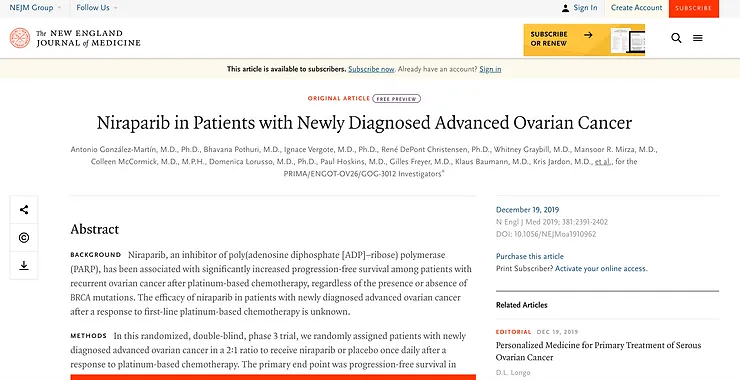 Figure 1
 Figure 2
 Figure 3
 Figure 4