
TIGIT Checkpoint: Overcoming PD-1 Resistance in Advanced Lung Cancer
Medical Supporter — Information Notice
This article is a summary of international medical information and is not medical advice; it cannot replace the diagnosis or treatment plan of your attending physician. The medical technologies, drug information and clinical data presented here are compiled from public literature and official statements of Japanese medical institutions; the applicability and outcome of any therapy vary with each patient and must be assessed individually by a qualified physician.
Clinical Context: The PD-1 Resistance Challenge
Despite the notable clinical success of PD-1/PD-L1 inhibitors in non-small cell lung cancer (NSCLC) immunotherapy, a significant proportion of patients demonstrate limited therapeutic benefit or primary resistance. Contemporary research efforts focus on identifying complementary immune checkpoint targets to overcome this limitation. TIGIT (T-cell immunoreceptor with Ig and ITIM domains) is one of the targets being studied in this context, including in the ARC-7 Phase II trial of Domvanalimab (not yet approved in Japan)-based combination regimens.
ARC-7 Phase II Trial: Dual Immune Checkpoint Blockade
This randomized, open-label Phase II clinical trial specifically enrolled treatment-naïve patients with PD-L1 high-expressing tumors (tumor proportion score ≥50%) without actionable driver mutations, comparing monotherapy versus combination approaches.
Key Clinical Findings:
Objective Response Rate (ORR): The trial reported observations on tumor response for the combination of the anti-TIGIT antibody Domvanalimab plus the anti-PD-1 antibody Zimberelimab (not yet approved in Japan), compared with PD-1 inhibitor monotherapy. Efficacy and safety have not been established in Japan.
Progression-Free Survival (PFS): The trial also reported PFS observations for the dual combination and the triple combination with etrumadenant, compared with monotherapy.
Mechanistic Rationale: TIGIT and PD-1 represent distinct inhibitory signaling pathways within the immune system. Blocking both checkpoints at the same time is being studied as a way to activate immune cells through complementary mechanisms.
Safety and Tolerability Profile
Interim trial analysis demonstrated that the adverse event profile of Domvanalimab combination therapy was consistent with prior immunotherapy experience, with no unexpected or grade 4-5 toxicities observed. Long-term safety is still being evaluated.
TIGIT as a Next-Generation Immunotherapy Target
TIGIT protein is broadly expressed on both natural killer (NK) cells and T lymphocytes. Selective TIGIT blockade is being studied as a way to enhance anti-tumor immunity. TIGIT-directed therapies are still being evaluated in clinical trials and are not approved in Japan.
※ The drug Domvanalimab mentioned in this article is currently not approved in Japan. This content is only a summary of published research. To learn about the options that can be considered now, we suggest talking first with your attending physician.
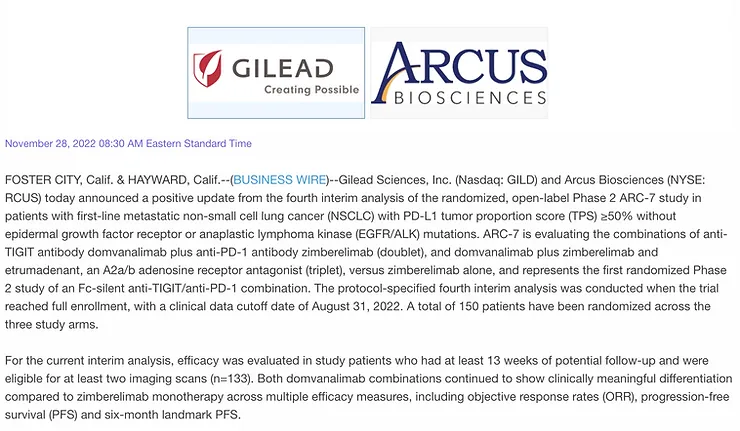 Figure 1
 Figure 2
 Figure 3
 Figure 4