
Sotorasib in KRAS G12C-Mutated Metastatic Colorectal Cancer: CodeBreaK 100 Trial
Medical Supporter — Information Notice
This article is a summary of international medical information and is not medical advice; it cannot replace the diagnosis or treatment plan of your attending physician. The medical technologies, drug information and clinical data presented here are compiled from public literature and official statements of major Japanese medical institutions; the applicability and outcome of any therapy vary with each patient and must be assessed individually by a qualified physician.
Medical Supporter — Information Notice
This article is a summary of international medical information and is not medical advice; it cannot replace the diagnosis or treatment plan of your attending physician. The medical technologies, drug information and clinical data presented here are compiled from public literature and official statements of major Japanese medical institutions; the applicability and outcome of any therapy vary with each patient and must be assessed individually by a qualified physician.
On December 14, 2021, Marwan G. Fakih and colleagues from the City of Hope Comprehensive Cancer Center published the results of the CodeBreaK 100 (NCT03600883) Phase 2 clinical trial in The Lancet Oncology. This study focused on the colorectal cancer (CRC) cohort of patients with KRAS G12C-mutated advanced solid tumors treated with Sotorasib.
Study Design: CodeBreaK 100 CRC Cohort
This open-label, multicenter Phase 2 trial enrolled 62 patients with KRAS G12C-mutated metastatic colorectal cancer who had progressed after prior standard therapies. All patients received Sotorasib at a dose of 960 mg orally once daily.
The primary endpoint was the objective response rate (ORR). Secondary endpoints included the disease control rate (DCR) and progression-free survival (PFS).
Key Efficacy Results
- Objective Response Rate (ORR): 9.7% (6 out of 62 patients).
- All six responders achieved a partial response (PR).
- Disease Control Rate (DCR): 82.3%
- Median Progression-Free Survival (PFS): 4.0 months.
While the response rate was lower than that observed in KRAS G12C-mutated non-small cell lung cancer, the high disease control rate suggests some degree of clinical activity in this challenging population.
Safety Profile
Sotorasib was generally well-tolerated:
- Grade 3 Adverse Events: Occurred in 10% of patients, with diarrhea (3%) being the most common.
- Grade 4 Adverse Events: One patient (2%) experienced elevated blood creatine phosphokinase.
- No treatment-related deaths were reported.
Conclusion
The researchers concluded that while the ORR of 9.7% did not meet the predefined target for the monotherapy cohort, Sotorasib demonstrates a manageable safety profile and evidence of disease stability in heavily pretreated KRAS G12C-mutated metastatic CRC. Current research is exploring Sotorasib in combination with other agents (such as EGFR inhibitors) to enhance its efficacy in colorectal cancer.
Source: The Lancet Oncology - CodeBreaK 100 Colorectal Cancer Results
#ColorectalCancer #KRASG12C #Sotorasib #CodeBreaK100 #PrecisionMedicine #CancerResearch
Considering medical care in Japan? Need information and support?
We help you organize the information needed for medical travel to Japan, liaise with Japanese medical institutions, and arrange a second-opinion consultation.The first consultation is free; an advisor will help you clarify the next steps.
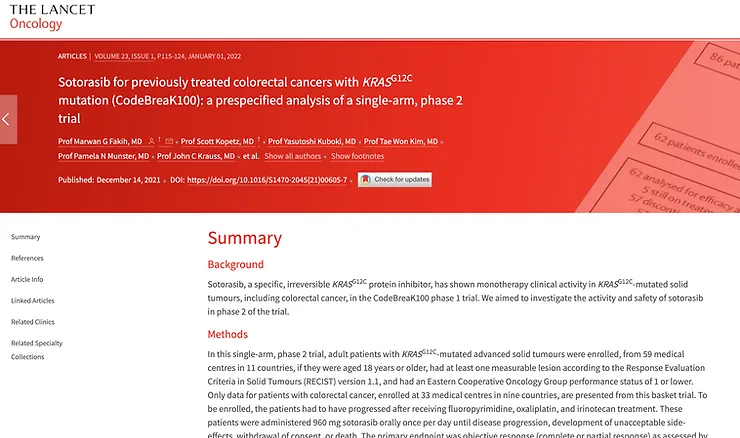 Figure 1
 Figure 2
 Figure 3
 Figure 4