
Enhertu Redefines Treatment for HER2-Low Metastatic Breast Cancer: DESTINY-Breast04
Medical Supporter — Information Notice
This article is a summary of international medical information and is not medical advice; it cannot replace the diagnosis or treatment plan of your attending physician. The medical technologies, drug information and clinical data presented here are compiled from public literature and official statements of major Japanese medical institutions; the applicability and outcome of any therapy vary with each patient and must be assessed individually by a qualified physician.
Medical Supporter — Information Notice
This article is a summary of international medical information and is not medical advice; it cannot replace the diagnosis or treatment plan of your attending physician. The medical technologies, drug information and clinical data presented here are compiled from public literature and official statements of major Japanese medical institutions; the applicability and outcome of any therapy vary with each patient and must be assessed individually by a qualified physician.
On June 5, 2022, Shanu Modi and colleagues from Memorial Sloan Kettering Cancer Center presented the practice-changing results of the DESTINY-Breast04 Phase 3 clinical trial at the ASCO Annual Meeting and simultaneously published them in The New England Journal of Medicine. This trial investigated the efficacy of Enhertu (Trastuzumab deruxtecan) in patients with HER2-low metastatic breast cancer.
Defining a New Category: HER2-Low
Traditionally, breast cancer was classified as either HER2-positive or HER2-negative. The DESTINY-Breast04 trial focused on patients previously considered "HER2-negative" but who had low levels of HER2 expression (IHC 1+ or IHC 2+/ISH negative). This group represents approximately 50-60% of all breast cancer patients.
Study Design: DESTINY-Breast04 Trial
The trial randomized 557 patients with pretreated HER2-low metastatic breast cancer in a 2:1 ratio:
- Enhertu Group (N=373): 5.4 mg/kg every 3 weeks.
- Physician’s Choice of Chemotherapy (N=184): Capecitabine, eribulin, gemcitabine, paclitaxel, or nab-paclitaxel.
The primary endpoint was progression-free survival (PFS) in the hormone receptor-positive (HR+) cohort.
Key Survival Results
HR-Positive Cohort (N=494)
- Median PFS: 10.1 months (Enhertu) vs. 5.4 months (Chemotherapy).
- Median OS: 23.9 months (Enhertu) vs. 17.5 months (Chemotherapy).
All Patients (Including HR-Negative)
- Median PFS: 9.9 months (Enhertu) vs. 5.1 months (Chemotherapy).
- Median OS: 23.4 months (Enhertu) vs. 16.8 months (Chemotherapy).
Conclusion
The DESTINY-Breast04 trial is considered one of the most important studies in the history of breast cancer treatment. It proved that Enhertu can target and kill cancer cells with low HER2 expression through its "bystander effect." This has established Enhertu as the new standard of care for HER2-low metastatic breast cancer, offering a much more effective option than traditional chemotherapy for a vast majority of patients.
Source: The New England Journal of Medicine - DESTINY-Breast04 Results
#BreastCancer #HER2Low #Enhertu #TDXd #DESTINYBreast04 #CancerResearch #PrecisionMedicine
Considering medical care in Japan? Need information and support?
We help you organize the information needed for medical travel to Japan, liaise with Japanese medical institutions, and arrange a second-opinion consultation.The first consultation is free; an advisor will help you clarify the next steps.
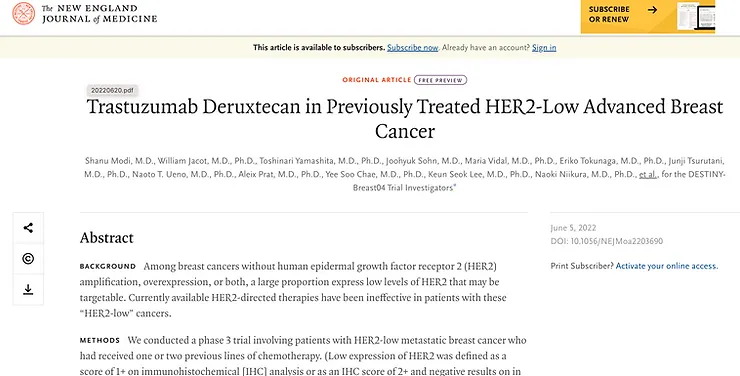 Figure 1
 Figure 2
 Figure 3
 Figure 4