
Camizestrant (SERD) in HR+/HER2- Advanced Breast Cancer: SERENA-2 Trial
Medical Supporter — Information Notice
This article is a summary of international medical information and is not medical advice; it cannot replace the diagnosis or treatment plan of your attending physician. The medical technologies, drug information and clinical data presented here are compiled from public literature and official statements of major Japanese medical institutions; the applicability and outcome of any therapy vary with each patient and must be assessed individually by a qualified physician.
Medical Supporter — Information Notice
This article is a summary of international medical information and is not medical advice; it cannot replace the diagnosis or treatment plan of your attending physician. The medical technologies, drug information and clinical data presented here are compiled from public literature and official statements of major Japanese medical institutions; the applicability and outcome of any therapy vary with each patient and must be assessed individually by a qualified physician.
On October 26, 2022, AstraZeneca announced the positive results of the SERENA-2 Phase 2 clinical trial, evaluating Camizestrant, a next-generation oral selective estrogen receptor degrader (SERD), in patients with hormone receptor-positive (HR+), HER2-negative advanced breast cancer.
Study Design: SERENA-2 Trial
The SERENA-2 trial is a randomized, open-label, multi-dose Phase 2 study. It compared different doses of Camizestrant (75 mg or 150 mg) against the current standard-of-care SERD, Faslodex (Fulvestrant, 500 mg), in patients who had previously received at least one line of endocrine therapy for advanced disease.
The primary endpoint was progression-free survival (PFS).
Key Results
The trial met its primary endpoint, showing a statistically significant and clinically meaningful improvement in PFS for patients receiving Camizestrant compared to those receiving Fulvestrant:
- Superior Efficacy: Both the 75 mg and 150 mg doses of Camizestrant reduced the risk of disease progression or death.
- Safety Profile: Camizestrant was well-tolerated, with a safety profile consistent with previous studies. No new safety signals were identified.
Conclusion
Dr. Mafalda Oliveira from the Vall d'Hebron Institute of Oncology stated that the SERENA-2 results provide strong evidence for the potential of Camizestrant as a new treatment option. By outperforming Fulvestrant—a standard therapy for over 20 years—Camizestrant demonstrates the importance of next-generation SERDs in addressing the needs of patients with HR+ advanced breast cancer.
Source: AstraZeneca Press Release - SERENA-2 Results
#BreastCancer #Camizestrant #SERD #HRPositive #Faslodex #CancerResearch #SERENA2
Considering medical care in Japan? Need information and support?
We help you organize the information needed for medical travel to Japan, liaise with Japanese medical institutions, and arrange a second-opinion consultation.The first consultation is free; an advisor will help you clarify the next steps.
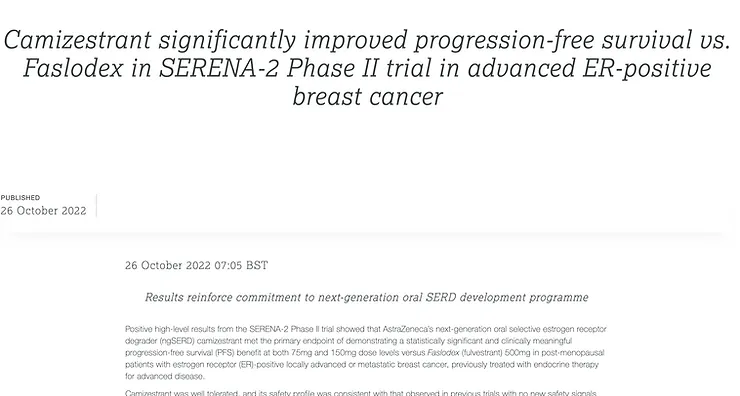 Figure 1
 Figure 2
 Figure 3
 Figure 4