
(Breast Cancer) FDA Approves Keytruda as Neoadjuvant and Adjuvant Therapy
Medical Supporter — Information Notice
This article is a summary of international medical information and is not medical advice; it cannot replace the diagnosis or treatment plan of your attending physician. The medical technologies, drug information and clinical data presented here are compiled from public literature and official statements of major Japanese medical institutions; the applicability and outcome of any therapy vary with each patient and must be assessed individually by a qualified physician.
- August 6, 2021
- Reading time: 1 minute
On July 26, 2021, the US Food and Drug Administration (FDA) approved pembrolizumab (Keytruda) plus chemotherapy as neoadjuvant therapy followed by single-agent Keytruda as adjuvant therapy for early-stage triple-negative breast cancer (TNBC). Additionally, in November 2020, the FDA had previously granted accelerated approval for Keytruda plus chemotherapy for patients with locally recurrent unresectable or metastatic TNBC whose tumors express PD-L1 (CPS ≥10).
Trial Design: KEYNOTE-522
This approval was based on KEYNOTE-522 (NCT03036488), a multicenter, double-blind trial that randomized previously untreated early-stage TNBC patients (N=1,174) in a 2:1 ratio to:
- Keytruda group: Keytruda + chemotherapy as neoadjuvant therapy, followed by single-agent Keytruda as adjuvant therapy
- Placebo group
Primary endpoints: Pathologic complete response (pCR) rate and event-free survival (EFS).
Efficacy Results
- pCR rate: Keytruda group 63% / Placebo group 56%
- Event-free survival: Keytruda group improved by 16% / Placebo group improved by 24%
Safety Profile
Adverse events occurring in ≥20% of Keytruda-treated patients: fatigue, asthenia, nausea, constipation, diarrhea, decreased appetite, rash, vomiting, cough, dyspnea, fever, alopecia, peripheral neuropathy, stomatitis, headache, weight loss, abdominal pain, arthralgia, myalgia, and insomnia.
Recommended Dosing
For TNBC patients: Keytruda 200 mg every 3 weeks or 400 mg every 6 weeks. Duration: Keytruda + chemotherapy for 24 weeks (neoadjuvant); single-agent Keytruda for 27 weeks (adjuvant).
- Clinical trial drug
- Immunotherapy
Medical Supporter was formerly certified as an international medical visa guarantor by Japan's Ministry of Foreign Affairs and the Ministry of Economy, Trade and Industry (B-066).
Considering medical care in Japan? Need information and support?
We help you organize the information needed for medical travel to Japan, liaise with Japanese medical institutions, and arrange a second-opinion consultation.The first consultation is free; an advisor will help you clarify the next steps.
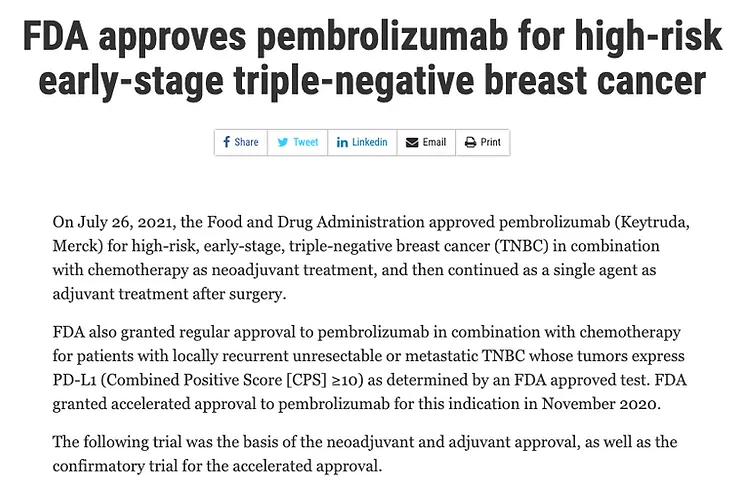 Figure 1
 Figure 2
 Figure 3
 Figure 4