
(Lung Cancer) Is Opdivo + Yervoy Effective?
Medical Supporter — Information Notice
This article is a summary of international medical information and is not medical advice; it cannot replace the diagnosis or treatment plan of your attending physician. The medical technologies, drug information and clinical data presented here are compiled from public literature and official statements of major Japanese medical institutions; the applicability and outcome of any therapy vary with each patient and must be assessed individually by a qualified physician.
On November 21, 2019, Matthew D. Hellmann published in The New England Journal of Medicine the "Efficacy and Safety Results of Combined Anti-PD-1 Antibody Opdivo (nivolumab) Plus Anti-CTLA-4 Antibody Yervoy (ipilimumab) as First-Line Treatment in Non-Small Cell Lung Cancer Patients in the CheckMate 227 Phase III Clinical Trial."
The CheckMate 227 Phase III clinical trial divided non-small cell lung cancer patients into two parts (Part 1a and Part 1b). The primary endpoint was overall survival in patients with PD-L1 expression of 1% or more, and the secondary endpoint was objective response rate.
Part 1a: Patients with NSCLC and PD-L1 expression of 1% or more were randomized to three groups as first-line treatment:
- Opdivo combination group (every 2 weeks: Opdivo 3mg/kg + every 6 weeks: Yervoy 1mg/kg)
- Opdivo monotherapy group (every 2 weeks: Opdivo 240mg)
- Chemotherapy group (every 3 weeks, up to 4 cycles)
Part 1b: Patients with NSCLC and PD-L1 expression below 1% were randomized to three groups:
- Opdivo combination group (every 2 weeks: Opdivo 3mg/kg + every 6 weeks: Yervoy 1mg/kg)
- Opdivo + chemotherapy group (every 3 weeks: Opdivo 360mg + chemotherapy, up to 4 cycles)
- Chemotherapy group (every 3 weeks, up to 4 cycles)
Patient backgrounds for the Opdivo combination and chemotherapy groups:
- Median age: 64 years (both groups)
- Sex: Opdivo combination: male 67.4%, female 32.6% / Chemotherapy: male 66.0%, female 34.0%
- Performance status: Opdivo combination ECOG=0: 35.0%, ECOG=1: 64.7% / Chemotherapy ECOG=0: 32.8%, ECOG=1: 66.2%
- Histology: Opdivo combination: squamous 28.0%, non-squamous 71.9% / Chemotherapy: squamous 27.8%, non-squamous 72.2%
- PD-L1: Opdivo combination: <1%: 32.1%, ≥1%: 67.9% / Chemotherapy: <1%: 31.9%, ≥1%: 68.1%
- TMB: Opdivo combination: ≥10mut/Mb: 42.1%, <10mut/Mb: 57.9% / Chemotherapy: ≥10mut/Mb: 45.8%, <10mut/Mb: 54.2%
Results for PD-L1 ≥1% (Part 1a): The median overall survival (primary endpoint) was 17.1 months for the Opdivo combination group versus 14.9 months for chemotherapy, showing improvement. The 1-year and 2-year overall survival rates were 62.6% and 40.0% for the Opdivo combination group versus 56.2% and 32.8% for chemotherapy. The objective response rate (secondary endpoint) was 35.9% versus 30.0%.
Results for PD-L1 <1% (Part 1b): The median overall survival was 17.2 months for the Opdivo combination group versus 12.2 months for chemotherapy, showing improvement. The 2-year overall survival rates were 40.4% for the Opdivo combination group versus 23.0% for chemotherapy.
Safety: The adverse event rate for all patients (Part 1a and 1b) was 76.7% for the Opdivo combination group versus 81.9% for chemotherapy. The most commonly observed adverse events were: Opdivo combination (diarrhea 17.0%, skin disorders 17.0%, fatigue 14.4%, decreased appetite 13.2%) versus chemotherapy (nausea 36.1%, anemia 33.0%, decreased appetite 19.6%, fatigue 18.9%, neutropenia 17.2%).
The rate of serious adverse events was 24.5% for the Opdivo combination group versus 13.9% for chemotherapy. Treatment discontinuation due to adverse events was 18.1% versus 9.1%, and treatment-related deaths were 1.4% versus 1.1%.
Based on the CheckMate 227 trial results, Matthew D. Hellmann concluded: "First-line treatment with anti-PD-1 antibody Opdivo plus anti-CTLA-4 antibody Yervoy improved overall survival compared to chemotherapy in non-small cell lung cancer patients, regardless of PD-L1 expression level."
Source: Nivolumab plus Ipilimumab in Advanced Non–Small-Cell Lung Cancer (N Engl J Med. 2019 Nov 21;381(21):2020-2031. doi: 10.1056/NEJMoa1910231.)
Medical Supporter was formerly certified as an international medical visa guarantor by Japan's Ministry of Foreign Affairs and the Ministry of Economy, Trade and Industry (B-066).
Considering medical care in Japan? Need information and support?
We help you organize the information needed for medical travel to Japan, liaise with Japanese medical institutions, and arrange a second-opinion consultation.The first consultation is free; an advisor will help you clarify the next steps.
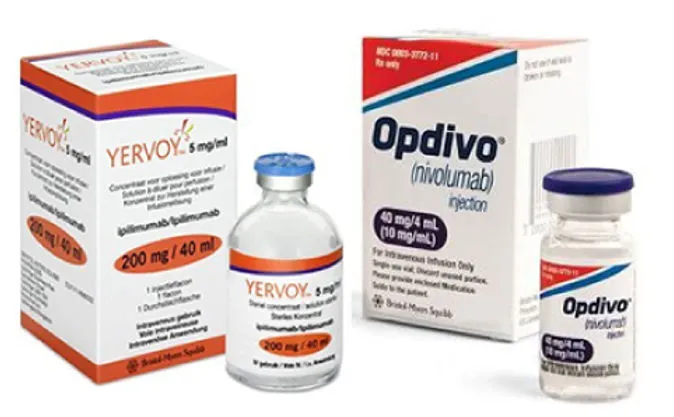 Figure 1
 Figure 2
 Figure 3
 Figure 4