
Is Savolitinib Effective for Lung Cancer?
Medical Supporter — Information Notice
This article is a summary of international medical information and is not medical advice; it cannot replace the diagnosis or treatment plan of your attending physician. The medical technologies, drug information and clinical data presented here are compiled from public literature and official statements of major Japanese medical institutions; the applicability and outcome of any therapy vary with each patient and must be assessed individually by a qualified physician.
From March 30 to April 2, 2022, Alfredo Addeo and colleagues from Geneva University Hospital presented the results of a Phase 2 clinical trial of the oral MET inhibitor Savolitinib in patients with MET exon 14 skipping mutation-positive non-small cell lung cancer (NSCLC) at the European Lung Cancer Congress (ELCC) in Prague, Czech Republic.
This Phase 2 trial evaluated the efficacy and safety of Savolitinib in 70 patients with MET exon 14 skipping mutation-positive NSCLC. The primary endpoint was overall survival (OS).
Of the 70 participants, 42 had prior treatment and 28 were treatment-naive. Histological types included 25 patients with pulmonary sarcomatoid carcinoma (PSC) and 45 with other NSCLC subtypes. The results were as follows:
With a median follow-up of 28.4 months, the median OS for all patients was 12.5 months. The 18-month OS rate was 42%, and the 24-month OS rate was 31%.
For PSC patients, the median OS was 10.6 months, with an 18-month OS rate of 30% and a 24-month OS rate of 26%.
For patients with other NSCLC subtypes, the median OS was 17.3 months, with an 18-month OS rate of 49% and a 24-month OS rate of 34.7%.
Regarding safety, the incidence of Grade 3 or higher adverse events was 46%. The most common Grade 3 or higher adverse events were AST elevation (13%), ALT elevation (10%), and peripheral edema (9%).
Based on these Phase 2 results, Alfredo Addeo stated that MET exon 14 skipping mutations occur in approximately 3-5% of NSCLC patients and serve as a clinically meaningful driver mutation for targeted therapy. Furthermore, given the poor prognosis of PSC, Savolitinib shows promising utility for this patient population.
Medical Supporter was formerly certified as an international medical visa guarantor by Japan's Ministry of Foreign Affairs and the Ministry of Economy, Trade and Industry (B-066).
Considering medical care in Japan? Need information and support?
We help you organize the information needed for medical travel to Japan, liaise with Japanese medical institutions, and arrange a second-opinion consultation.The first consultation is free; an advisor will help you clarify the next steps.
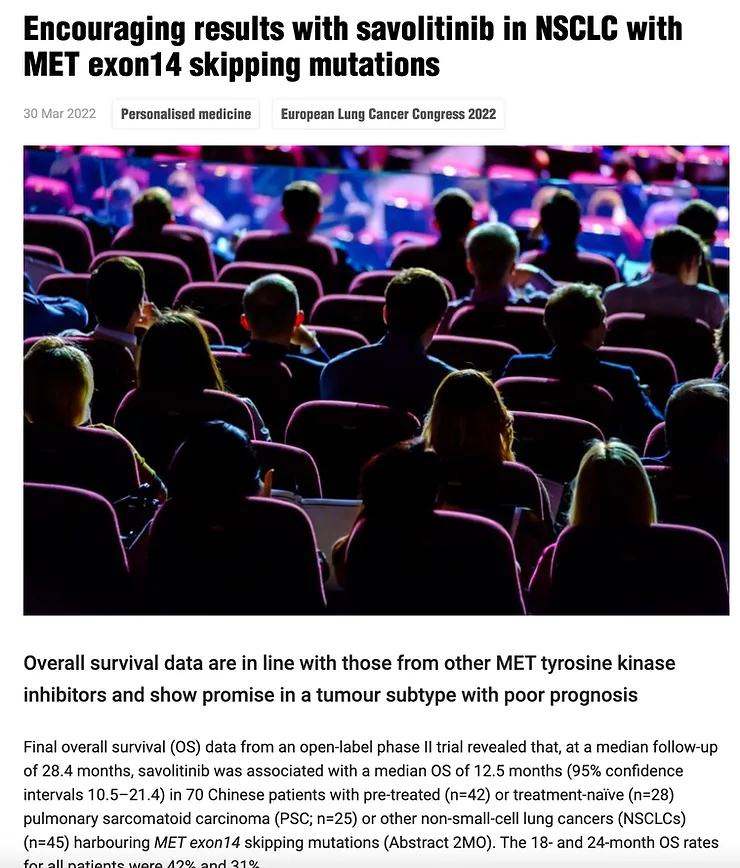 Figure 1
 Figure 2
 Figure 3
 Figure 4