
(Lung Cancer) Is Keytruda Effective?
Medical Supporter — Information Notice
This article is a summary of international medical information and is not medical advice; it cannot replace the diagnosis or treatment plan of your attending physician. The medical technologies, drug information and clinical data presented here are compiled from public literature and official statements of major Japanese medical institutions; the applicability and outcome of any therapy vary with each patient and must be assessed individually by a qualified physician.
On June 3, 2023, Heather Wakelee et al. from Stanford University published the results of the Phase 3 KEYNOTE-671 clinical trial in "The New England Journal of Medicine," evaluating the efficacy and safety of Keytruda as perioperative (pre- and post-operative) chemotherapy for patients with early-stage non-small cell lung cancer (NSCLC).
This trial randomly assigned patients with stage II-IIIB NSCLC in a 1:1 ratio to either the Keytruda group (pre-operative pembrolizumab with chemotherapy followed by post-operative pembrolizumab monotherapy) or the placebo group. The primary endpoints were event-free survival (EFS) and overall survival (OS). Secondary endpoints included major pathological response (mPR), pathological complete response (pCR), and safety.
At a median follow-up of 25.2 months, the 24-month event-free survival rates (a primary endpoint) were 62.4% for the Keytruda group and 40.6% for the placebo group. The 24-month overall survival rates (another primary endpoint) were 80.9% for the Keytruda group and 77.6% for the placebo group.
For secondary endpoints, the major pathological response rates were 30.2% in the Keytruda group and 11.0% in the placebo group. The pathological complete response rates were 18.1% in the Keytruda group and 4.0% in the placebo group.
In terms of safety, the incidence of grade 3 or higher adverse events was 44.9% in the Keytruda group and 37.3% in the placebo group. The incidence of grade 5 or higher adverse events was 1.0% in the Keytruda group and 0.8% in the placebo group.
Based on the results of the KEYNOTE-671 trial, Heather Wakelee et al. stated that the use of Keytruda as perioperative chemotherapy in patients with early-stage NSCLC significantly improved event-free survival, major pathological response, and pathological complete response compared to the placebo group. However, no significant difference in overall survival was confirmed in this analysis.
Source: https://www.nejm.org/doi/full/10.1056/NEJMoa2302983?query=featured_home?query=featured_home
Medical Supporter was formerly certified as an international medical visa guarantor by Japan's Ministry of Foreign Affairs and the Ministry of Economy, Trade and Industry (B-066).
Considering medical care in Japan? Need information and support?
We help you organize the information needed for medical travel to Japan, liaise with Japanese medical institutions, and arrange a second-opinion consultation.The first consultation is free; an advisor will help you clarify the next steps.
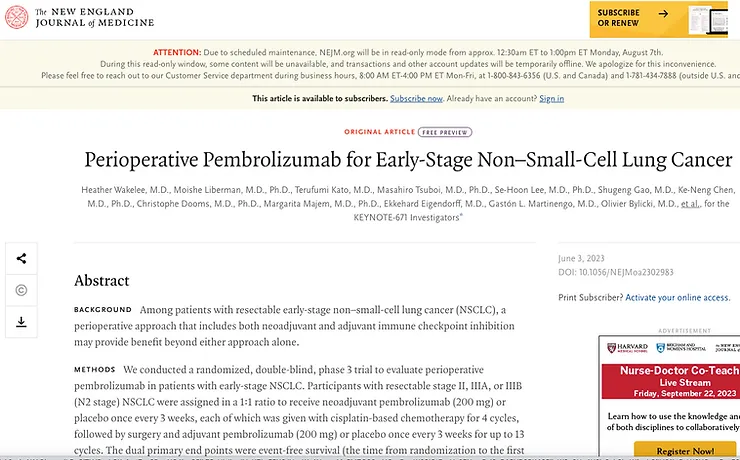 Figure 1
 Figure 2
 Figure 3
 Figure 4