
(Endometrial Cancer) FDA Grants Accelerated Approval of Dostarlimab for dMMR Patients
Medical Supporter — Information Notice
This article is a summary of international medical information and is not medical advice; it cannot replace the diagnosis or treatment plan of your attending physician. The medical technologies, drug information and clinical data presented here are compiled from public literature and official statements of major Japanese medical institutions; the applicability and outcome of any therapy vary with each patient and must be assessed individually by a qualified physician.
- May 3, 2021
- Read time: 1 minute
On April 22, 2021, the U.S. Food and Drug Administration (FDA) granted accelerated approval of dostarlimab for endometrial cancer patients with mismatch repair deficiency (dMMR) as determined by an approved diagnostic test, whose disease has progressed during or after platinum-containing chemotherapy.
This approval was based on the evaluation of efficacy in Cohort A1 of the GARNET trial (NCT02715284), a multicenter, non-blinded, multi-cohort study conducted at multiple facilities in patients with advanced solid tumors. The efficacy cohort included 71 endometrial cancer patients with dMMR confirmed by an approved test, whose disease had progressed during or after platinum-containing chemotherapy. Patients received dostarlimab 500 mg every 3 weeks for 4 cycles, then 1,000 mg every 6 weeks thereafter.
The primary endpoints were objective response rate and duration of response. The objective response rate was 42.3%, comprising complete response 12.7% and partial response 29.6%. The median duration of response was not reached; 93.3% of patients maintained a response duration of 6 months or longer.
Serious adverse events occurred in 34% of patients; serious adverse events occurring in ≥2% included sepsis, acute kidney injury, urinary tract infection, abdominal pain, and fever. The most common adverse events (≥20%) were fatigue, weakness, nausea, diarrhea, anemia, and constipation. The most common Grade 3 or 4 adverse events (≥2%) were anemia and elevated transaminases. Immune-related adverse events may include pneumonitis, colitis, hepatitis, endocrine disorders, and nephritis.
The recommended dose of dostarlimab is 500 mg every 3 weeks (doses 1–4), then 1,000 mg every 6 weeks starting 3 weeks after the 4th dose, until disease progression or intolerable adverse events. Dostarlimab is administered intravenously over approximately 30 minutes.
Medical Supporter was formerly certified as an international medical visa guarantor by Japan's Ministry of Foreign Affairs and the Ministry of Economy, Trade and Industry (B-066).
Considering medical care in Japan? Need information and support?
We help you organize the information needed for medical travel to Japan, liaise with Japanese medical institutions, and arrange a second-opinion consultation.The first consultation is free; an advisor will help you clarify the next steps.
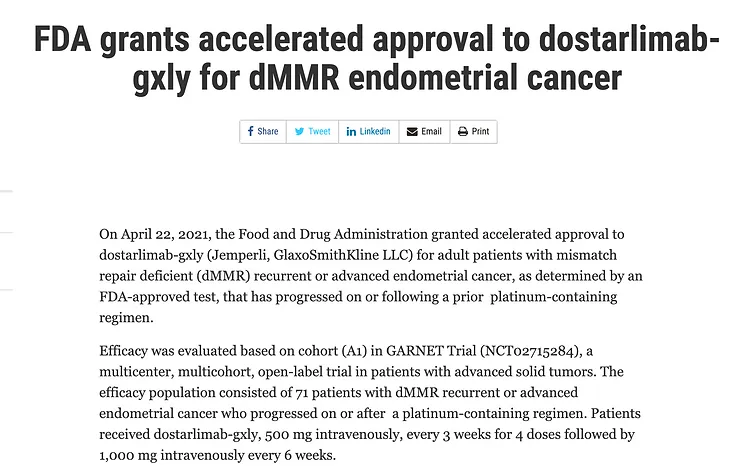 Figure 1
 Figure 2
 Figure 3
 Figure 4