
Lynparza as Adjuvant Therapy in High-Risk Early Breast Cancer: OlympiA Trial
Medical Supporter — Information Notice
This article is a summary of international medical information and is not medical advice; it cannot replace the diagnosis or treatment plan of your attending physician. The medical technologies, drug information and clinical data presented here are compiled from public literature and official statements of major Japanese medical institutions; the applicability and outcome of any therapy vary with each patient and must be assessed individually by a qualified physician.
Medical Supporter — Information Notice
This article is a summary of international medical information and is not medical advice; it cannot replace the diagnosis or treatment plan of your attending physician. The medical technologies, drug information and clinical data presented here are compiled from public literature and official statements of major Japanese medical institutions; the applicability and outcome of any therapy vary with each patient and must be assessed individually by a qualified physician.
On October 10, 2022, C.E. Geyer Jr. and colleagues from the UPMC Hillman Cancer Center published the long-term follow-up results of the OlympiA Phase 3 clinical trial in Annals of Oncology. The study investigated the efficacy and safety of Lynparza (Olaparib) as an adjuvant therapy for patients with BRCA1/2-mutated, high-risk, HER2-negative early breast cancer.
Study Design: OlympiA Phase 3 Trial
OlympiA was a double-blind, randomized Phase 3 trial involving 1,836 patients with germline BRCA1 or BRCA2 mutations and high-risk early breast cancer who had completed local treatment and neoadjuvant or adjuvant chemotherapy.
Participants were randomized 1:1 to receive:
- Lynparza (Olaparib) Group: 300 mg twice daily for one year.
- Placebo Group: One year of placebo.
Patients with hormone receptor-positive disease also received standard endocrine therapy.
Key Survival Results (Median Follow-up 3.5 Years)
Overall Survival (OS)
- 4-Year OS Rate: 89.8% for the Lynparza group vs. 86.4% for the placebo group.
- Lynparza demonstrated a statistically significant improvement in overall survival.
Invasive Disease-Free Survival (iDFS)
- 4-Year iDFS Rate: 82.7% (Lynparza) vs. 75.4% (Placebo).
Distant Disease-Free Survival (DDFS)
- 4-Year DDFS Rate: 86.5% (Lynparza) vs. 79.1% (Placebo).
Conclusion
The authors concluded that adjuvant Lynparza significantly improves overall survival, invasive disease-free survival, and distant disease-free survival in patients with germline BRCA1/2 mutations and high-risk early breast cancer. These results solidify Olaparib's role as a vital treatment option in this specific genetic patient population.
Source: Annals of Oncology - OlympiA Trial Long-term Follow-up
#BreastCancer #BRCAMutation #Lynparza #Olaparib #OlympiATrial #CancerResearch
Considering medical care in Japan? Need information and support?
We help you organize the information needed for medical travel to Japan, liaise with Japanese medical institutions, and arrange a second-opinion consultation.The first consultation is free; an advisor will help you clarify the next steps.
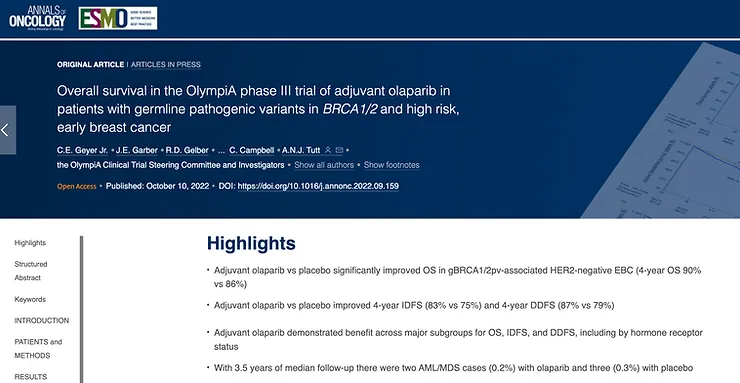 Figure 1
 Figure 2
 Figure 3
 Figure 4