
Capivasertib Plus Paclitaxel in Triple-Negative Breast Cancer: PAKT Trial
Medical Supporter — Information Notice
This article is a summary of international medical information and is not medical advice; it cannot replace the diagnosis or treatment plan of your attending physician. The medical technologies, drug information and clinical data presented here are compiled from public literature and official statements of major Japanese medical institutions; the applicability and outcome of any therapy vary with each patient and must be assessed individually by a qualified physician.
Medical Supporter — Information Notice
This article is a summary of international medical information and is not medical advice; it cannot replace the diagnosis or treatment plan of your attending physician. The medical technologies, drug information and clinical data presented here are compiled from public literature and official statements of major Japanese medical institutions; the applicability and outcome of any therapy vary with each patient and must be assessed individually by a qualified physician.
On December 16, 2019, Dr. Peter Schmid and colleagues published the results of the PAKT Phase 2 clinical trial in the Journal of Clinical Oncology. The study evaluated the efficacy of Capivasertib, an AKT inhibitor, in combination with Paclitaxel as a first-line treatment for patients with metastatic triple-negative breast cancer (TNBC).
Study Design: PAKT Trial
The trial randomized 140 patients with metastatic TNBC in a 1:1 ratio:
- Capivasertib Group (N=70): Capivasertib (400 mg twice daily, 4 days on/3 days off) + Paclitaxel (90 mg/m² on days 1, 8, 15 of a 28-day cycle).
- Placebo Group (N=70): Placebo + Paclitaxel.
The primary endpoint was progression-free survival (PFS), and the secondary endpoint was overall survival (OS).
Key Survival Results
Total Population
- Median PFS: 5.9 months for the Capivasertib group vs. 4.2 months for the placebo group (Hazard Ratio [HR] = 0.74).
- Median OS: 19.1 months (Capivasertib) vs. 12.6 months (Placebo) (HR = 0.61).
Patients with PIK3CA/AKT1/PTEN Mutations (N=28)
In patients with specific genetic alterations in the PI3K/AKT/PTEN pathway, the benefit was even more pronounced:
- Median PFS: 9.3 months (Capivasertib) vs. 3.7 months (Placebo).
- Risk Reduction: A 70% reduction in the risk of disease progression or death (HR = 0.30).
Safety Profile
Common Grade 3 or higher adverse events in the Capivasertib group included diarrhea (13% vs. 1% in placebo), infection (4%), and rash/skin reactions (4%).
Conclusion
The PAKT trial concluded that the addition of Capivasertib to first-line Paclitaxel significantly improves both PFS and OS in patients with metastatic TNBC. The efficacy is notably higher in patients with alterations in the PIK3CA, AKT1, or PTEN genes, highlighting the potential for biomarker-driven therapy in TNBC.
Source: Journal of Clinical Oncology - PAKT Trial Results
#BreastCancer #TNBC #Capivasertib #AKTInhibitor #PAKT #CancerResearch #PrecisionMedicine
Considering medical care in Japan? Need information and support?
We help you organize the information needed for medical travel to Japan, liaise with Japanese medical institutions, and arrange a second-opinion consultation.The first consultation is free; an advisor will help you clarify the next steps.
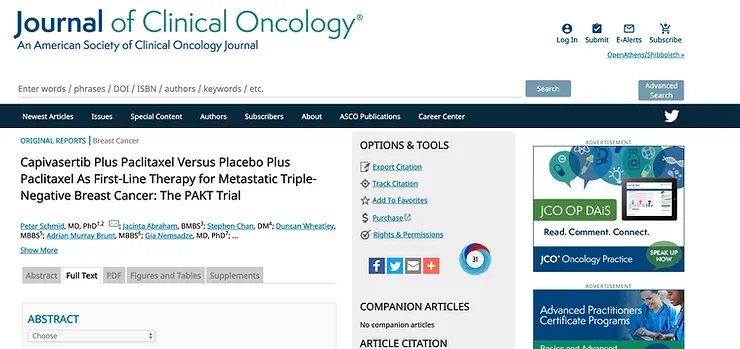 Figure 1
 Figure 2
 Figure 3
 Figure 4