
Capecitabine as Adjuvant Therapy for Biliary Tract Cancer: BILCAP Trial
Medical Supporter — Information Notice
This article is a summary of international medical information and is not medical advice; it cannot replace the diagnosis or treatment plan of your attending physician. The medical technologies, drug information and clinical data presented here are compiled from public literature and official statements of major Japanese medical institutions; the applicability and outcome of any therapy vary with each patient and must be assessed individually by a qualified physician.
Medical Supporter — Information Notice
This article is a summary of international medical information and is not medical advice; it cannot replace the diagnosis or treatment plan of your attending physician. The medical technologies, drug information and clinical data presented here are compiled from public literature and official statements of major Japanese medical institutions; the applicability and outcome of any therapy vary with each patient and must be assessed individually by a qualified physician.
On March 22, 2022, John Bridgewater and colleagues from the UCL Cancer Institute published the long-term follow-up results of the BILCAP Phase 3 clinical trial in the Journal of Clinical Oncology. The study investigated the efficacy of capecitabine as an adjuvant therapy for patients with biliary tract cancer (BTC) who had undergone radical surgical resection.
Study Design: BILCAP Phase 3 Trial
BILCAP was a multicenter, randomized Phase 3 trial involving 447 patients who had undergone complete resection for BTC. Participants were randomized 1:1 into two groups:
- Capecitabine Group (N=223): Capecitabine 1,250 mg/m² twice daily on days 1–14 of a 21-day cycle, for a total of 8 cycles.
- Observation Group (N=224): Monitoring without active adjuvant therapy.
The primary endpoint was overall survival (OS).
Long-term Follow-up Results (Median 106 Months)
- Median Overall Survival: 49.6 months for the capecitabine group vs. 36.1 months for the observation group.
- Risk Reduction: The capecitabine group showed a 16% reduction in the risk of death (Hazard Ratio [HR] = 0.84).
- Adjusted Analysis: After adjusting for factors such as nodal status, tumor grade, and sex, the risk of death was reduced by 26% (HR = 0.74).
Conclusion
The authors concluded that adjuvant capecitabine significantly improves overall survival in patients with BTC following surgical resection. Based on these findings, capecitabine is established as a standard of care for adjuvant therapy in this patient population.
Source: Journal of Clinical Oncology - BILCAP Trial Results
#BiliaryTractCancer #Cholangiocarcinoma #Capecitabine #BILCAPTrial #CancerResearch #AdjuvantTherapy
Considering medical care in Japan? Need information and support?
We help you organize the information needed for medical travel to Japan, liaise with Japanese medical institutions, and arrange a second-opinion consultation.The first consultation is free; an advisor will help you clarify the next steps.
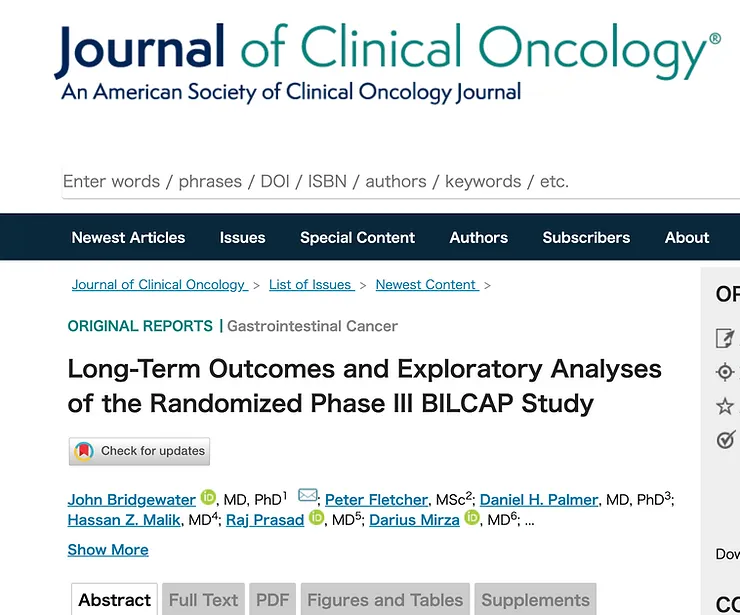 Figure 1
 Figure 2
 Figure 3
 Figure 4