
(Ovarian Cancer) Is Rucaparib Effective?
Medical Supporter — Information Notice
This article is a summary of international medical information and is not medical advice; it cannot replace the diagnosis or treatment plan of your attending physician. The medical technologies, drug information and clinical data presented here are compiled from public literature and official statements of major Japanese medical institutions; the applicability and outcome of any therapy vary with each patient and must be assessed individually by a qualified physician.
On March 14, 2022, Rebecca Kristeleit et al. of Guy's and St Thomas' NHS Foundation Trust published in the medical journal The Lancet the efficacy and safety results of PARP inhibitor Rucaparib in the Phase 3 ARIEL4 clinical trial in heavily pretreated, BRCA1/2-mutant ovarian cancer, fallopian tube cancer, and primary peritoneal cancer patients.
ARIEL4 was an international multicenter, randomized Phase 3 clinical trial enrolling patients with two or more prior treatments and BRCA1/2-mutant ovarian cancer, fallopian tube cancer, and primary peritoneal cancer (N=349), randomized 2:1 to Rucaparib group (twice daily, 600 mg, N=233) or standard chemotherapy group. The primary endpoint was progression-free survival.
The median age of enrolled patients was 58 years, with 95% white race (N=332). Trial results were as follows.
At a median follow-up of 25.0 months, the primary endpoint median progression-free survival was: Rucaparib group 7.4 months / standard chemotherapy group 5.7 months. Compared to the standard chemotherapy group, the Rucaparib group showed a significant 33% improvement in mortality risk.
Regarding safety, the most commonly confirmed Grade 3 or higher adverse events were anemia and decreased hemoglobin. The incidence of adverse events was: Rucaparib group 22% (N=52/232) / standard chemotherapy group 5% (N=6/113). Serious adverse event incidence was: Rucaparib group 27% (N=62) / standard chemotherapy group 12% (N=13). There were 3 Rucaparib treatment-related deaths, due to cardiac disease, myelodysplastic syndrome, and unknown causes, respectively.
Based on the ARIEL4 trial results, Rebecca Kristeleit et al. stated: In heavily pretreated, BRCA1/2-mutant ovarian cancer, fallopian tube cancer, and primary peritoneal cancer patients, PARP inhibitor Rucaparib has the potential to replace standard chemotherapy.
Source: https://www.thelancet.com/journals/lanonc/article/PIIS1470-2045(22)00122-X/fulltext
Medical Supporter was formerly certified as an international medical visa guarantor by Japan's Ministry of Foreign Affairs and the Ministry of Economy, Trade and Industry (B-066).
Considering medical care in Japan? Need information and support?
We help you organize the information needed for medical travel to Japan, liaise with Japanese medical institutions, and arrange a second-opinion consultation.The first consultation is free; an advisor will help you clarify the next steps.
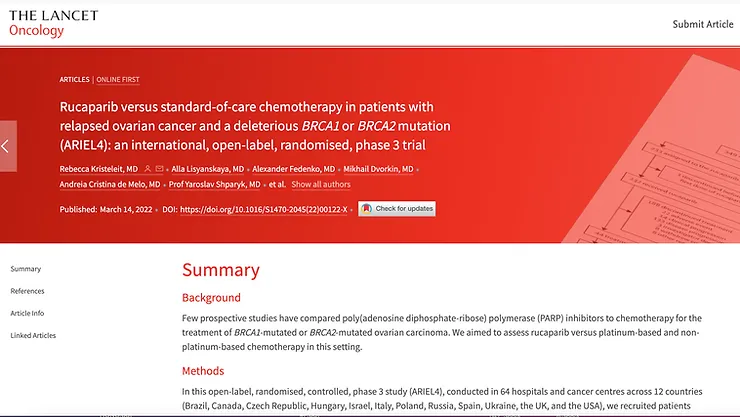 Figure 1
 Figure 2
 Figure 3
 Figure 4