
(Head and Neck Cancer) How Effective Is RM-1929 Near-Infrared Photoimmunotherapy?
Medical Supporter — Information Notice
This article is a summary of international medical information and is not medical advice; it cannot replace the diagnosis or treatment plan of your attending physician. The medical technologies, drug information and clinical data presented here are compiled from public literature and official statements of major Japanese medical institutions; the applicability and outcome of any therapy vary with each patient and must be assessed individually by a qualified physician.
- December 5, 2019
- Reading time: 2 minutes
Updated: January 27, 2020
At the American Society of Clinical Oncology (ASCO) meeting held in Chicago on June 1, 2019, researchers presented results demonstrating clinically significant antitumor activity of RM-1929 combined with near-infrared photoimmunotherapy in previously treated patients with locally recurrent head and neck cancer.
Background
The rationale for this trial was based on the limited treatment options and poor prognosis for recurrent head and neck cancer patients, combined with the high EGFR expression in head and neck cancer. RM-1929 is composed of IR700 conjugated with the anti-EGFR antibody cetuximab. The goal was that using this novel targeted antibody drug in photoimmunotherapy would make cancer cells easier to target and destroy, potentially offering patients a new treatment option.
Trial Design
This Phase IIa multicenter trial enrolled patients with head and neck cancer who were inoperable and could not be effectively treated with radiation therapy or platinum-based chemotherapy. The trial evaluated the safety and efficacy of RM-1929.
Treatment method: RM-1929 administered intravenously, followed 24 hours later by near-infrared light irradiation of tumors. Irradiation could be delivered by surface illumination or via optical fiber inserted into deep tumors.
Efficacy Results
- Overall response rate (ORR): 43%
- Complete response: 13% (4 patients)
- Partial response: 30% (9 patients)
- Median PFS: 5.2 months
- Median OS: 9.3 months
Treatment data for RM-1929 plus photoimmunotherapy exceeded standard treatment benchmarks. Future trials combining RM-1929 with other treatment modalities are planned.
Safety Profile
No patients experienced dose-limiting toxicity or photosensitive skin reactions. Most patients tolerated adverse events well. Serious adverse events occurred in 43.3% (13 patients): treatment-site pain, tumor bleeding, and swelling.
Expert Commentary
Clinical development lead Jeannie Hou stated: "The Phase IIa results presented will be closely linked to upcoming clinical trials. This trial selectively targeted cancer cells using the antibody drug combined with localized near-infrared irradiation, minimizing photoimmunotherapy's impact on normal tissue. Based on these results, we look forward to favorable outcomes in the upcoming international Phase 3 trial."
Source: https://meetinglibrary.asco.org/record/163296/abstract
Tags: #Photoimmunotherapy #HeadNeckCancer #RM1929
- Immunotherapy
- Clinical trial drug
Medical Supporter was formerly certified as an international medical visa guarantor by Japan's Ministry of Foreign Affairs and the Ministry of Economy, Trade and Industry (B-066).
Considering medical care in Japan? Need information and support?
We help you organize the information needed for medical travel to Japan, liaise with Japanese medical institutions, and arrange a second-opinion consultation.The first consultation is free; an advisor will help you clarify the next steps.
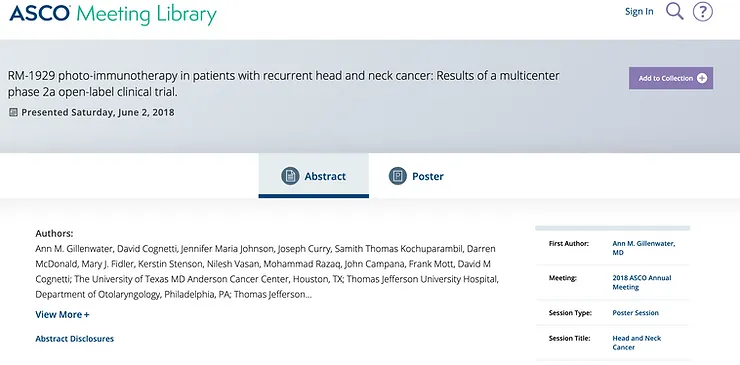 Figure 1
 Figure 2
 Figure 3
 Figure 4