
(Lymphoma) Keytruda Approval Application Submitted for PMBCL
Medical Supporter — Information Notice
This article is a summary of international medical information and is not medical advice; it cannot replace the diagnosis or treatment plan of your attending physician. The medical technologies, drug information and clinical data presented here are compiled from public literature and official statements of major Japanese medical institutions; the applicability and outcome of any therapy vary with each patient and must be assessed individually by a qualified physician.
On December 5, 2022, MSD K.K. announced the submission of an approval application to Japan's Ministry of Health, Labour and Welfare (MHLW) for the anti-PD-1 antibody drug Keytruda (pembrolizumab) in patients with relapsed or refractory primary mediastinal large B-cell lymphoma (PMBCL).
This application was based on results from the overseas KEYNOTE-170 Phase II clinical trial and the Japan-domestic KEYNOTE-A33 Phase I clinical trial. Both trials enrolled previously treated patients with relapsed or refractory PMBCL. Patients received Keytruda 200 mg monotherapy on a 21-day cycle. The trials evaluated efficacy and safety, and demonstrated durable and sustained anti-tumor effects.
MSD K.K. stated in its press release: In the field of oncology, we will continue to advance the development of innovative drugs and strive to obtain approvals to meet the needs of patients and healthcare professionals.
Source: https://www.msd.co.jp/news/product-news-20221205/
Medical Supporter was formerly certified as an international medical visa guarantor by Japan's Ministry of Foreign Affairs and the Ministry of Economy, Trade and Industry (B-066).
Considering medical care in Japan? Need information and support?
We help you organize the information needed for medical travel to Japan, liaise with Japanese medical institutions, and arrange a second-opinion consultation.The first consultation is free; an advisor will help you clarify the next steps.
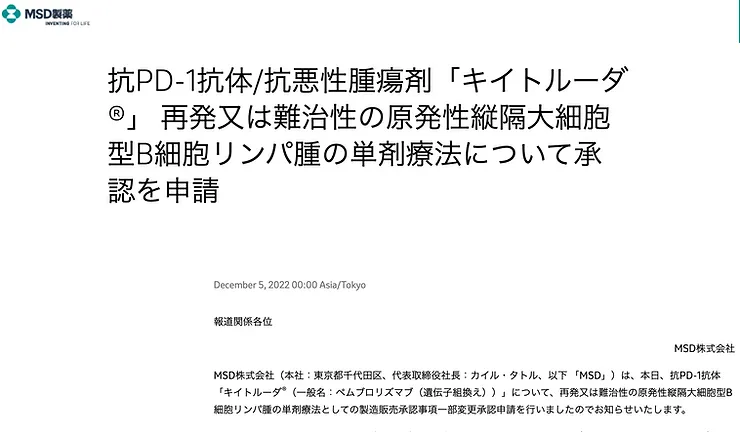 Figure 1
 Figure 2
 Figure 3
 Figure 4