
(Lymphoma) Is Keytruda Effective for PMBCL?
Medical Supporter — Information Notice
This article is a summary of international medical information and is not medical advice; it cannot replace the diagnosis or treatment plan of your attending physician. The medical technologies, drug information and clinical data presented here are compiled from public literature and official statements of major Japanese medical institutions; the applicability and outcome of any therapy vary with each patient and must be assessed individually by a qualified physician.
At the 63rd American Society of Hematology (ASH) Annual Meeting held from December 11–13, 2021, Pier Luigi Zinzani and colleagues from the Diagnostica e Sperimentale Università di Bologna presented 4-year follow-up results from the KEYNOTE-170 Phase II clinical trial evaluating the anti-PD-1 antibody Keytruda (pembrolizumab) in patients with relapsed or refractory primary mediastinal large B-cell lymphoma (PMBCL) who had received two or more prior therapies and were ineligible for transplant.
The KEYNOTE-170 Phase II trial enrolled relapsed or refractory PMBCL patients with two or more prior therapies who were ineligible for transplant (N=53). Patients received Keytruda 200 mg on a 3-week cycle for up to 35 cycles. Endpoints included objective response rate (ORR), progression-free survival (PFS), duration of response (DoR), and overall survival (OS).
At a median follow-up of 48.7 months, 13 of all patients completed 2 years of treatment, and 40 patients discontinued treatment — of whom 18 discontinued due to disease progression.
Efficacy Results:
- ORR: 41.5% (complete response 20.8%, partial response 20.8%)
- Median DoR: Not reached; 80.6% of responders maintained response for ≥48 months
- Median PFS: 4.3 months; 48-month PFS rate: 33.0%
- Median OS: 22.3 months; 48-month OS rate: 45.3%
Safety:
- Overall adverse event rate: 56.6% (N=30)
- Neutropenia: 18.9%; fatigue: 9.4%; hypothyroidism: 7.5%; malaise: 5.7%; fever: 5.7%
- Grade 3–4 adverse event rate: 22.6%; 7 patients experienced neutropenia
Based on the KEYNOTE-170 trial 4-year follow-up results, Pier Luigi Zinzani and colleagues concluded: In relapsed or refractory PMBCL patients with two or more prior therapies who were ineligible for transplant, Keytruda demonstrated durable anti-tumor effects, with improving trends in both PFS and OS.
Source: https://ash.confex.com/ash/2021/webprogram/Paper148082.html
Medical Supporter was formerly certified as an international medical visa guarantor by Japan's Ministry of Foreign Affairs and the Ministry of Economy, Trade and Industry (B-066).
Considering medical care in Japan? Need information and support?
We help you organize the information needed for medical travel to Japan, liaise with Japanese medical institutions, and arrange a second-opinion consultation.The first consultation is free; an advisor will help you clarify the next steps.
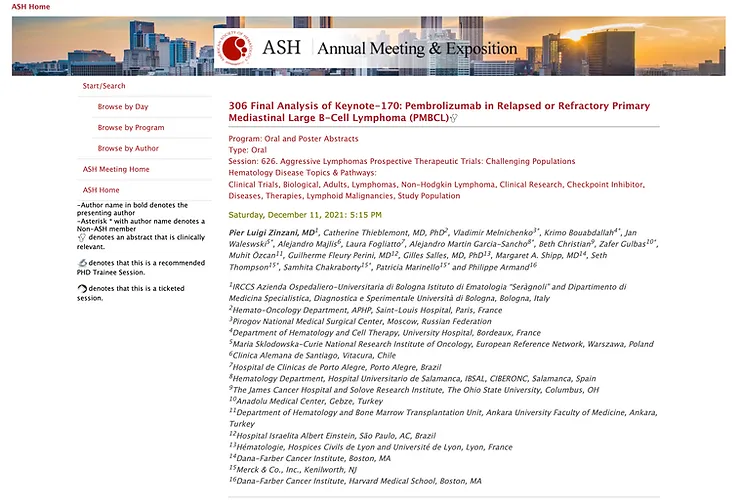 Figure 1
 Figure 2
 Figure 3
 Figure 4