
(Pediatrics) Proton Beam Therapy
Medical Supporter — Information Notice
This article is a summary of international medical information and is not medical advice; it cannot replace the diagnosis or treatment plan of your attending physician. The medical technologies, drug information and clinical data presented here are compiled from public literature and official statements of major Japanese medical institutions; the applicability and outcome of any therapy vary with each patient and must be assessed individually by a qualified physician.
- November 21, 2017
- Read time: 2 minutes
Pediatric tumors have always been a particularly challenging condition. Dosing differs greatly from adults, and children's bodies are not yet fully developed, requiring very careful management during treatment.
In Kobe, Japan, the Prefectural Particle Beam Center opened on December 1. This radiation therapy center specializes in pediatric tumors, offering both heavy-ion and proton therapy. The facility has no hospital beds, so hospitalization requires admission to a neighboring hospital such as Kobe University Hospital or the Children's Hospital. Among Japan's 18 particle beam centers, this is the first dedicated to pediatric tumors. For children aged 0-19, proton beam therapy is the available form of radiation treatment at this facility.
This radiation therapy center has three floors. To prevent nosocomial infections, there is a dedicated corridor. Additionally, this facility also provides heavy-ion therapy for adults. The appropriate treatment modality must be determined following clinical consultation at the facility.
Source: Kobe Shimbun and Japan Yahoo News. https://www.kobe-np.co.jp/news/iryou/201711/0010710443.shtml
Original text (Japanese): Hyogo Prefecture announced on the 6th that it will open the Kobe Proton Therapy Center on December 1 at Port Island in Kobe's Chuo Ward — a medical facility conducting particle beam therapy with emphasis on pediatric cancer. It is an affiliated clinic of the Prefectural Particle Beam Medical Center (in Tatsuno City) and has no inpatient beds. It will be connected to the neighboring Prefectural Children's Hospital by an elevated walkway, and will cooperate with nearby institutions such as Kobe University Hospital and the City Medical Center Chuo Citizen's Hospital for adult cancer treatment.
As the 18th particle beam treatment facility nationwide. It is reportedly the first nationwide to have a dedicated irradiation room for pediatric proton beam treatment.
Particle beam therapy uses radiation called "particle beams," which differs from conventional X-rays. It has the property of releasing energy in a concentrated peak at deeper body locations, enabling precise targeting of cancer while minimizing burden on the body. Types include proton beam therapy (using hydrogen atomic nuclei) and carbon ion therapy (using heavier carbon atomic nuclei); the new facility uses proton beams.
The Kobe Proton Therapy Center has 4 radiation oncologists and 1 anesthesiologist on staff. Total project cost is approximately 10.3 billion yen. The reinforced concrete 4-story building (partially steel frame) covers approximately 6,000 square meters of total floor space, and is equipped with 2 proton beam irradiation units ("gantries"). The third floor has 2 treatment irradiation rooms; one is exclusively for ages 0-19, with a treatment bed that can be lowered, and the interior is designed with illustrated murals. A dedicated corridor for infection-risk children, including the walkway to the Children's Hospital, is also provided.
The first floor is primarily used for consultations and examinations for adult cancer patients. The main hospital's Particle Beam Treatment Center also has heavy-ion therapy facilities, and consultations on whether proton or carbon ion therapy is more appropriate can be conducted at the Kobe Proton Therapy Center.
Article written by (Yamaiji Susumu)
Medical Supporter was formerly certified as an international medical visa guarantor by Japan's Ministry of Foreign Affairs and the Ministry of Economy, Trade and Industry (B-066).
Considering medical care in Japan? Need information and support?
We help you organize the information needed for medical travel to Japan, liaise with Japanese medical institutions, and arrange a second-opinion consultation.The first consultation is free; an advisor will help you clarify the next steps.
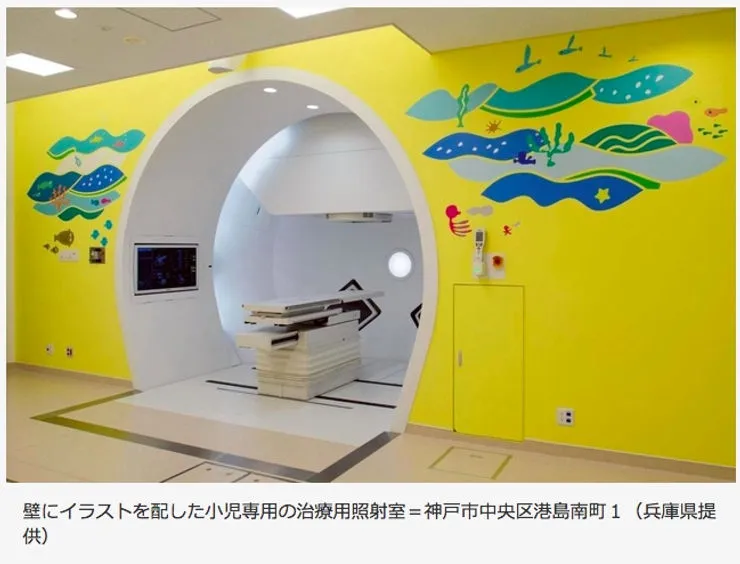 Figure 1
 Figure 2
 Figure 3
 Figure 4