
(Ovarian Cancer) Is Veliparib Monotherapy Effective as Maintenance Therapy?
Medical Supporter — Information Notice
This article is a summary of international medical information and is not medical advice; it cannot replace the diagnosis or treatment plan of your attending physician. The medical technologies, drug information and clinical data presented here are compiled from public literature and official statements of major Japanese medical institutions; the applicability and outcome of any therapy vary with each patient and must be assessed individually by a qualified physician.
On December 19, 2019, Robert L. Coleman published in The New England Journal of Medicine the "Efficacy and Safety Results of PARP Inhibitor Veliparib Plus Carboplatin Plus Paclitaxel as Induction Therapy Followed by Veliparib Monotherapy as Maintenance Therapy in Treatment-Naive Ovarian Cancer Patients in the VELIA/GOG-3005 Phase III Clinical Trial."
This Phase III clinical trial randomly assigned treatment-naive ovarian cancer patients in a 1:1:1 ratio to three groups. The primary endpoint was progression-free survival, and the secondary endpoint was overall survival:
- Arm 1: Veliparib + carboplatin + paclitaxel as induction (every 21 days), followed by Veliparib monotherapy as maintenance
- Arm 2: Veliparib + carboplatin + paclitaxel as induction (every 21 days), followed by placebo as maintenance
- Arm 3: Placebo + carboplatin + paclitaxel as induction (every 21 days), followed by placebo as maintenance
Trial results: Arm 1 showed significant improvement in the primary endpoint of PFS compared to Arm 3. The overall patient median PFS was 23.5 months for Arm 1 vs. 17.3 months for Arm 3, with a 32% reduction in PFS risk (HR 0.68).
BRCA mutation-positive patient median PFS was 34.7 months for Arm 1 vs. 22.0 months for Arm 3, with a 56% reduction in PFS risk (HR 0.44).
HRD-positive patient median PFS was 31.9 months for Arm 1 vs. 20.5 months for Arm 3, with a 43% reduction in PFS risk (HR 0.57).
For the secondary endpoint of overall survival, data for all patients, BRCA mutation-positive patients, and HRD-positive patients are not yet mature.
Safety: Overall adverse event rates: Arm 1 100%, Arm 2 100%, Arm 3 100%. Grade 3-4 adverse event rates: Arm 1 88%, Arm 2 88%, Arm 3 77%. The most commonly observed adverse events in Arm 1 were nausea (80%), neutropenia (75%), fatigue (69%), peripheral neuropathy (64%), anemia (64%), thrombocytopenia (58%), and alopecia (52%).
Based on the VELIA/GOG-3005 trial results, Robert L. Coleman concluded: "In treatment-naive ovarian cancer patients, PARP inhibitor Veliparib combined with carboplatin plus paclitaxel as induction therapy followed by Veliparib monotherapy as maintenance therapy showed significant improvement in progression-free survival."
Source: Veliparib with First-Line Chemotherapy and as Maintenance Therapy in Ovarian Cancer (N Engl J Med 2019; 381:2403-2415 DOI: 10.1056/NEJMoa1909707)
Medical Supporter was formerly certified as an international medical visa guarantor by Japan's Ministry of Foreign Affairs and the Ministry of Economy, Trade and Industry (B-066).
Considering medical care in Japan? Need information and support?
We help you organize the information needed for medical travel to Japan, liaise with Japanese medical institutions, and arrange a second-opinion consultation.The first consultation is free; an advisor will help you clarify the next steps.
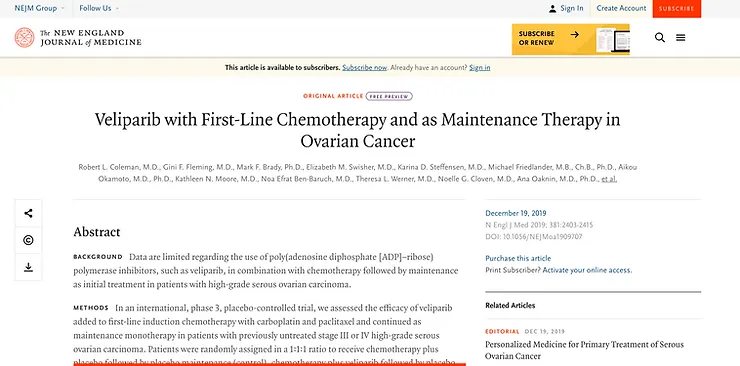 Figure 1
 Figure 2
 Figure 3
 Figure 4