
(Urothelial Carcinoma) Opdivo Approved as Postoperative Adjuvant Therapy in Japan
Medical Supporter — Information Notice
This article is a summary of international medical information and is not medical advice; it cannot replace the diagnosis or treatment plan of your attending physician. The medical technologies, drug information and clinical data presented here are compiled from public literature and official statements of major Japanese medical institutions; the applicability and outcome of any therapy vary with each patient and must be assessed individually by a qualified physician.
On March 28, 2022, Ono Pharmaceutical Co., Ltd. and Bristol-Myers Squibb announced that Opdivo (nivolumab) received domestic approval in Japan as a postoperative adjuvant therapy for urothelial carcinoma.
Urothelial carcinoma is a cancer that occurs in the renal pelvis, ureter, bladder, and urethra, with the bladder being the most common site. In Japan, approximately 37,000 new cases occur per year and approximately 11,000 deaths per year. Standard treatment for bladder cancer includes neoadjuvant chemotherapy and radical resection. However, more than 50% of patients experience recurrence after radical resection with poor prognosis, creating high medical demand for postoperative adjuvant therapy aimed at suppressing recurrence.
This approval was based on the CheckMate-274 Phase III clinical trial results, an international multicenter double-blind trial conducted in patients with muscle-invasive urothelial carcinoma who were at high risk of recurrence after radical resection of the primary bladder, renal pelvis, or ureter. Patients were randomly assigned in a 1:1 ratio to either the Opdivo group (every 2 weeks: 240mg) or the placebo group, evaluating all patients and patients with PD-L1 expression of 1% or more. The primary endpoint was progression-free survival, and secondary endpoints were overall survival, non-urothelial disease-free survival, and disease-specific survival.
The progression-free survival evaluated in all patients was 20.8 months for the Opdivo group versus 10.8 months for the placebo group, showing a significant extension. For patients with PD-L1 expression of 1% or more, progression-free survival was not reached for the Opdivo group versus 8.4 months for the placebo group, with a significant improvement observed.
The safety profile confirmed in this trial was consistent with that of other trials using Opdivo in solid tumors.
Since 2014, when Opdivo was first approved in Japan for malignant melanoma, it has become a treatment option for multiple cancers and has been approved in 65 countries including South Korea, China, the United States, and the EU. Clinical trials for hepatocellular carcinoma, ovarian cancer, bladder cancer, prostate cancer, pancreatic cancer, and cholangiocarcinoma are also ongoing.
Source: https://www.ono.co.jp/news/20220328.html
Medical Supporter was formerly certified as an international medical visa guarantor by Japan's Ministry of Foreign Affairs and the Ministry of Economy, Trade and Industry (B-066).
Considering medical care in Japan? Need information and support?
We help you organize the information needed for medical travel to Japan, liaise with Japanese medical institutions, and arrange a second-opinion consultation.The first consultation is free; an advisor will help you clarify the next steps.
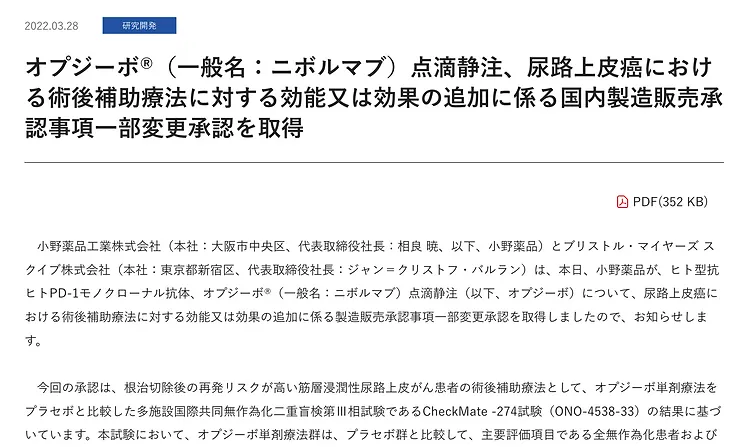 Figure 1
 Figure 2
 Figure 3
 Figure 4