
What Is Photoimmunotherapy (NIR-PIT)?
Medical Supporter — Information Notice
This article is a summary of international medical information and is not medical advice; it cannot replace the diagnosis or treatment plan of your attending physician. The medical technologies, drug information and clinical data presented here are compiled from public literature and official statements of major Japanese medical institutions; the applicability and outcome of any therapy vary with each patient and must be assessed individually by a qualified physician.
- September 28, 2019
- Reading time: 3 minutes
Near-infrared photoimmunotherapy (NIR-PIT) first involves intravenous administration of an antibody (IR700) that reacts chemically with near-infrared light. The antibodies that have bound to cancer cells are then irradiated with near-infrared light, triggering a chemical reaction that destroys the cancer cells.
Mechanism of Action
Near-infrared light occupies the wavelength range between visible light and infrared light. NIR-PIT uses near-infrared light at the shorter wavelength end (700 nanometers), which carries higher energy. IR700 is a dye called phthalocyanine that can absorb near-infrared energy at 700 nm. Through the chemical reaction generated by near-infrared irradiation, IR700 binds to antigens on the cancer cell membrane and causes protein changes. Once the cancer cell membrane is damaged, the cancer cell is destroyed within a very short time (approximately 1–2 minutes). Under microscopic observation, cancer cells exposed to near-infrared light burst one by one like balloons.
Since IR700 does not bind to normal cells other than cancer cells, normal cells are completely unaffected even when exposed to near-infrared light. Cancer cells that have bound to antibodies are only destroyed when irradiated with this specific near-infrared light. In other words, antibodies that have bound to cancer cells only react when irradiated with near-infrared light — making this a highly selective cancer treatment method that destroys antibody-bearing cancer cells. This represents the highest degree of cellular selectivity in cancer treatment currently available — unprecedented in the field.
Near-infrared light is the same type of light used in ordinary TV remote controls or instruments that test the sugar content of fruits. Unlike visible light, near-infrared light can penetrate deep into the human body and is completely harmless. More than 20 antibodies have been approved by the US FDA for use in cancer treatment, and they have been confirmed to have low toxicity. At present, treatment uses approved antibodies selected from this list. IR700 was originally insoluble in water and therefore could not be injected into the body, but by modifying its properties using silica, it can be dissolved in water. The IR700 administered for treatment is excreted in urine within one day and causes no harm to the body.
Applicable Cancer Types
NIR-PIT is effective not only for surface cancers like skin cancer, but also for cancers such as esophageal cancer, bladder cancer, colorectal cancer, liver cancer, pancreatic cancer, and renal cancer — approximately 80–90% of tumors can be treated with this approach. Depending on the tumor location, irradiation can be performed from outside the body or via endoscope. When tumors exceed 3 cm in size, a catheter with a fine needle is inserted into the tumor, the needle is withdrawn, a fiber optic cable is inserted, and near-infrared irradiation can be delivered from inside the tumor.
Applications for Metastatic Tumors
For metastatic tumor treatment with NIR-PIT, there are two approaches:
-
Direct cancer cell destruction: As described above, light irradiates antibody-bound cancer cells, destroying them and releasing various antigens (damaged proteins). Since normal cells are completely unaffected by the treatment, nearby healthy immune cells transmit the antigen information to lymphocytes, causing them to proliferate and attack. The proliferated lymphocytes can then travel through the lymphatic system to attack cancer cells carrying the same antigens in other parts of the body. This is the primary mechanism by which immune function is activated after NIR-PIT in metastatic tumors.
-
Regulatory T-cell depletion: A method published as a patent application last year, with a paper released in August. Rather than directly destroying cancer cells, this approach targets regulatory T cells (Tregs) that prevent immune cells from attacking cancer cells. IR700 binds to regulatory T cells, which are then eliminated upon near-infrared irradiation. This removes the interference preventing immune cells from attacking cancer cells — and within just a few tens of minutes, immune cells become activated and begin attacking cancer cells. Through blood circulation, within just a few hours, they can attack metastatic cancer cells. The immune cells educated within the tumor are trained to attack only cancer cells, so this approach does not carry the side effects of traditional immunotherapy, such as autoimmune diseases caused by excessive immune activation.
Tags: #Photoimmunotherapy
- Immunotherapy
Medical Supporter was formerly certified as an international medical visa guarantor by Japan's Ministry of Foreign Affairs and the Ministry of Economy, Trade and Industry (B-066).
Considering medical care in Japan? Need information and support?
We help you organize the information needed for medical travel to Japan, liaise with Japanese medical institutions, and arrange a second-opinion consultation.The first consultation is free; an advisor will help you clarify the next steps.
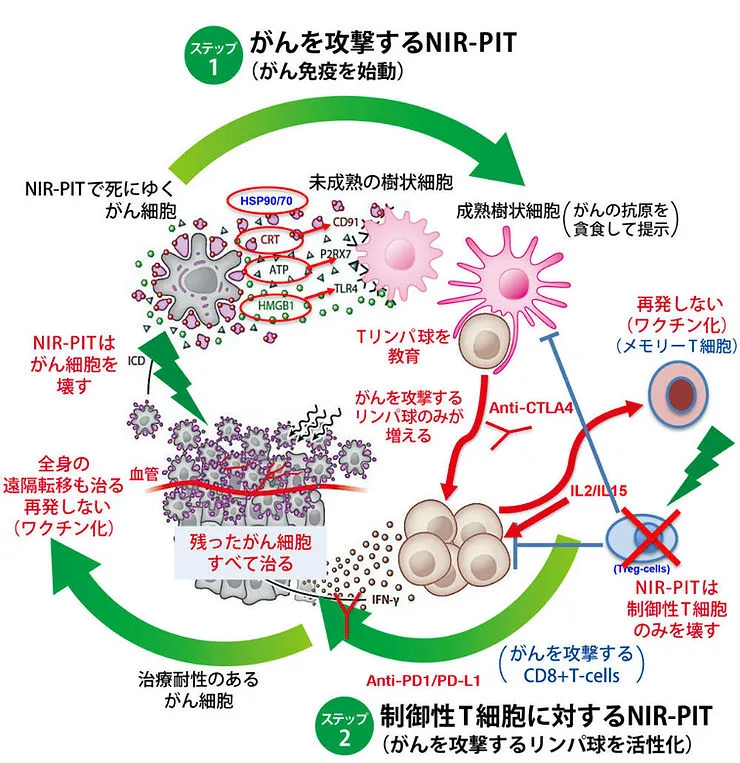 Figure 1
 Figure 2
 Figure 3
 Figure 4