Mie University Immunotherapy Information
Medical Supporter — Information Notice
This article is a summary of international medical information and is not medical advice; it cannot replace the diagnosis or treatment plan of your attending physician. The medical technologies, drug information and clinical data presented here are compiled from public literature and official statements of major Japanese medical institutions; the applicability and outcome of any therapy vary with each patient and must be assessed individually by a qualified physician.
- May 26, 2016
- Read time: 2 minutes
While searching for information and assisting our inquirers, we often discover new insights along the way. However, recently we have noticed that more family members are contacting us after midnight. We hope everyone takes care of their health — on the journey of fighting cancer, patients still need the support of their families. Please rest early and don't exhaust yourselves. Although you may feel urgency, some things cannot be rushed. If there is anything Medical Supporter can help with, please let us know anytime. We warmly welcome anyone interested in this field to contact us — whether you have Japanese language skills or a medical background.
Since some families have asked why we make related information public and whether we are not concerned about competitors: we hope more people can participate together, so we share all our know-how with you. As long as patients can have more choices and more complete support, that is our goal. Success doesn't have to be ours alone, but when you need us, we will always be here.
Mie University Hospital is the only university hospital in Mie Prefecture. Japan's physician shortage is not less severe than Taiwan's. Since medical school tuition in Japan can easily run into the millions of yen, students from less affluent families face significant financial pressure. And graduates of commerce or engineering faculties often earn no less than physicians in the end. I recall reading an article on PTT where a reporter interviewed students who achieved top scores in university entrance exams — almost all said they wanted to study medicine and become doctors. But then one student said: "If reporters earn more than doctors, I believe everyone here would want to study journalism."
Getting back on topic: Mie University School of Medicine is conducting clinical trials in two modes:
Mode 1: Anti-cancer Vaccine Clinical Trials
- Using CHP-NY-ESO-1 (*1) cancer-specific antigen for post-surgical esophageal cancer patients
- Combined CHP-NY-ESO-1 cancer vaccine and MIS416 therapy for prostate cancer patients
Mode 2: Cell Therapy Clinical Trials
- TCR gene therapy (MAGE-A4 antigen) for esophageal cancer patients, using T lymphocytes
- TCR gene therapy (WT1 antigen) for hematopoietic malignancies (siTCR-WT1-AML/MDS gene therapy clinical research)
- Chemotherapy-induction lymphocyte therapy, also using TCR gene therapy
*1 NY-ESO-1: A type of cancer-specific antigen; MAGE-A4 is another such antigen. Most are found only in cancer cells. This characteristic is exploited to direct lymphocytes to attack and kill cancer cells.
All clinical trials are in early phases (Phase 1). Participants must be adults aged 20 or older.
Mie University Hospital Website: http://www.hosp.mie-u.ac.jp Address: 2-174 Edobashi, Tsu City, Mie Prefecture 514-8507 Phone: 059-232-1111
Current five clinical trial programs:
Program 1: CHP-NY-ESO-1 anti-cancer vaccine for post-surgical esophageal cancer patients Target: Prostate cancer, esophageal cancer (patients unresponsive to conventional treatment)
Program 2: Combined CHP-NY-ESO-1 cancer vaccine and MIS416 therapy Target: Esophageal cancer (patients unresponsive to conventional treatment)
Program 3: TCR gene therapy (MAGE-A4 antigen) Target: Esophageal cancer
Program 4: TCR gene therapy (WT1 antigen) Target: Hematopoietic malignancies, leukemia
Program 5: TBI-1201 gene therapy Target: Esophageal cancer, head and neck cancer, ovarian cancer, etc. (unresponsive to conventional treatment)
Medical Supporter was formerly certified as an international medical visa guarantor by Japan's Ministry of Foreign Affairs and the Ministry of Economy, Trade and Industry (B-066).
Considering medical care in Japan? Need information and support?
We help you organize the information needed for medical travel to Japan, liaise with Japanese medical institutions, and arrange a second-opinion consultation.The first consultation is free; an advisor will help you clarify the next steps.
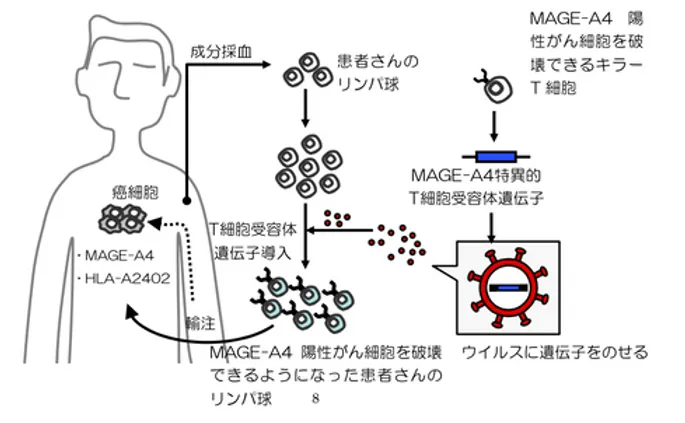 Figure 1
 Figure 2
 Figure 3
 Figure 4