
Keytruda in First-Line MSI-H/dMMR Metastatic Colorectal Cancer: KEYNOTE-177 Final Results
Medical Supporter — Information Notice
This article is a summary of international medical information and is not medical advice; it cannot replace the diagnosis or treatment plan of your attending physician. The medical technologies, drug information and clinical data presented here are compiled from public literature and official statements of major Japanese medical institutions; the applicability and outcome of any therapy vary with each patient and must be assessed individually by a qualified physician.
On April 12, 2022, Dr. Luis A. Diaz Jr. and colleagues from Memorial Sloan Kettering Cancer Center published the final analysis of the KEYNOTE-177 Phase 3 clinical trial in The Lancet Oncology. This landmark study evaluated Keytruda (Pembrolizumab) as a first-line treatment for patients with microsatellite instability-high (MSI-H) or mismatch repair-deficient (dMMR) metastatic colorectal cancer (mCRC).
Study Design: KEYNOTE-177 Trial
The trial randomized 307 patients with MSI-H/dMMR mCRC in a 1:1 ratio:
- Keytruda Group (N=153): 200 mg every three weeks.
- Chemotherapy Group (N=154): Physician's choice of standard chemotherapy (mFOLFOX6 or FOLFIRI, with or without Bevacizumab or Cetuximab).
Patients in the chemotherapy group were allowed to cross over to Keytruda upon disease progression.
Key Findings (Median Follow-up 44.5 Months)
Progression-Free Survival (PFS)
- Keytruda Group: 16.5 months
- Chemotherapy Group: 8.2 months
- Keytruda more than doubled the time patients lived without their disease worsening.
Overall Survival (OS)
- Keytruda Group: Median OS not reached.
- Chemotherapy Group: 36.7 months.
- While there was a positive trend, the difference in OS did not reach statistical significance, likely due to the high crossover rate (60%) from chemotherapy to subsequent immunotherapy.
Safety and Tolerability
- Grade 3+ Adverse Events: 22% in the Keytruda group vs. 66% in the chemotherapy group.
- Keytruda was significantly better tolerated with far fewer severe side effects compared to standard chemotherapy.
Conclusion
The final results of KEYNOTE-177 solidify Keytruda as the standard-of-care first-line therapy for patients with MSI-H/dMMR metastatic colorectal cancer. It offers superior durability of response and a much more favorable safety profile compared to traditional chemotherapy.
Source: The Lancet Oncology - KEYNOTE-177 Final Analysis
#ColorectalCancer #MSIH #dMMR #Keytruda #Pembrolizumab #KEYNOTE177 #Immunotherapy #CancerResearch
Considering medical care in Japan? Need information and support?
We help you organize the information needed for medical travel to Japan, liaise with Japanese medical institutions, and arrange a second-opinion consultation.The first consultation is free; an advisor will help you clarify the next steps.
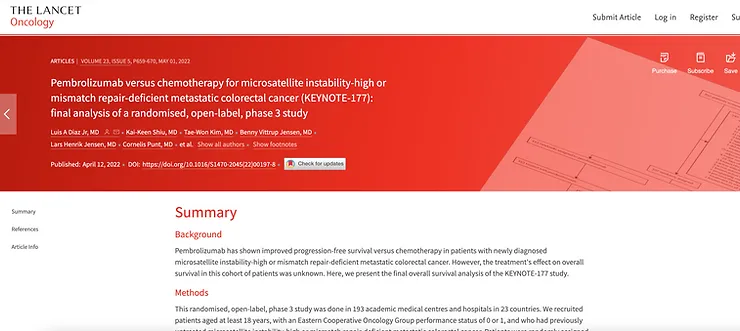 Figure 1
 Figure 2
 Figure 3
 Figure 4