(Regenerative Medicine) Spinal Cord Regeneration Using iPS Cells
Medical Supporter — Information Notice
This article is a summary of international medical information and is not medical advice; it cannot replace the diagnosis or treatment plan of your attending physician. The medical technologies, drug information and clinical data presented here are compiled from public literature and official statements of major Japanese medical institutions; the applicability and outcome of any therapy vary with each patient and must be assessed individually by a qualified physician.
Keio University Hospital will begin accepting patients starting June 28 for a clinical trial using human iPS cells to treat spinal cord injuries. Previously, there has been no effective treatment method for spinal cord injuries except rehabilitation. Currently, there are no other reports worldwide of using iPS cells to regenerate the spinal cord.
The clinical research is being conducted by a team led by Professor Masaya Nakamura (Orthopedics) and Professor Hideyuki Okano (Physiology) at Keio University Hospital. Approximately 2 million cells capable of transforming into nerves, cultured from another person's iPS cells, will be transplanted into patients whose spinal cords were damaged by traffic accidents, falls, or sports injuries. It is expected to take one year to verify safety and efficacy.
The plan is to initially accept one patient starting June 28. The target is patients aged 18 or older who have complete paralysis of motor and sensory functions during the subacute phase, within 2 to 4 weeks after spinal cord injury. After the first patient's transplant, three more patients will be recruited. The reason for selecting patients in the subacute phase is that the expectation for nerve regeneration effects is higher compared to patients in the chronic phase who have been injured for some time.
Source: https://news.yahoo.co.jp/articles/8264de109b048af86421d4a997fe50dbd3e8c778
Medical Supporter was formerly certified as an international medical visa guarantor by Japan's Ministry of Foreign Affairs and the Ministry of Economy, Trade and Industry (B-066).
Considering medical care in Japan? Need information and support?
We help you organize the information needed for medical travel to Japan, liaise with Japanese medical institutions, and arrange a second-opinion consultation.The first consultation is free; an advisor will help you clarify the next steps.
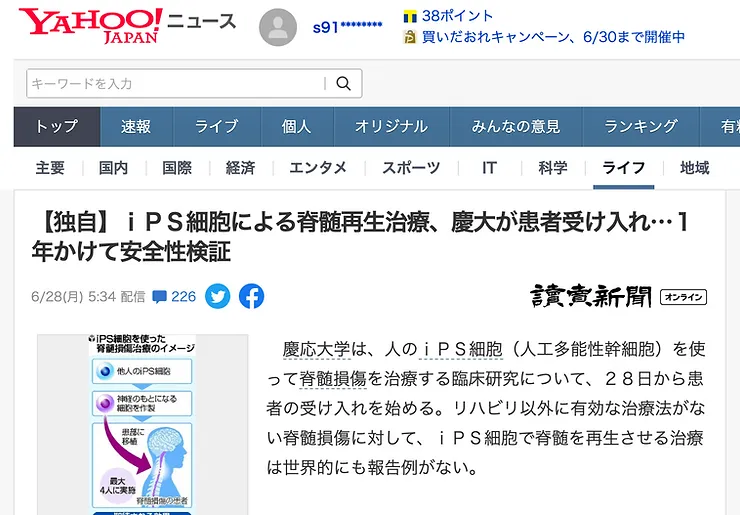 Figure 1
 Figure 2
 Figure 3
 Figure 4