University of Tokyo Research Results on Heavy-Ion Beam Irradiation
Medical Supporter — Information Notice
This article is a summary of international medical information and is not medical advice; it cannot replace the diagnosis or treatment plan of your attending physician. The medical technologies, drug information and clinical data presented here are compiled from public literature and official statements of major Japanese medical institutions; the applicability and outcome of any therapy vary with each patient and must be assessed individually by a qualified physician.
A research team led by Special Researcher Tomomi Watanabe-Asaka, Associate Professor Shoji Oda, and Professor Hiroshi Mitani from the Graduate School of Frontier Sciences at the University of Tokyo conducted a study on heavy-ion beam irradiation, a form of radiation therapy. By irradiating the surface of fish and performing section analysis, the team investigated the systemic effects of this treatment. While researchers have long suspected that local irradiation could affect other parts of the body, this study provides new insights into the systemic impact of heavy-ion beams on living organisms.
The study used the ion beam irradiation facility (TIARA) at the Takasaki Advanced Radiation Research Institute (TARRI). Using Medaka (rice fish) as a model organism—due to their being vertebrates like humans and their small size facilitating thorough analysis—the team locally irradiated them with heavy-ion beams. The researchers found that local irradiation also affected blood vessels in areas that did not receive direct irradiation. Specifically, 3D imaging of kidney tissue revealed atrophy in irradiated areas, while non-irradiated areas also showed vascular changes.
Professor Hiroshi Mitani of the research team noted, "Heavy-ion beams have a stronger biological effect and can be aimed more precisely than X-rays or gamma rays, making them highly effective for cancer treatment. This discovery represents a significant step forward in fundamental research for cancer therapy." Special Researcher Tomomi Watanabe-Asaka added, "Future research will use Medaka to explore the mechanisms of microvascular dilation and its relationship to inflammatory responses."
This study was conducted jointly by the University of Tokyo, the Takasaki Advanced Radiation Research Institute, Kitasato University, and Yamaguchi University. Related section data has been made available by the Yamaguchi University team.
Note: The fish species used was Medaka (rice fish), also known as "Oryzias latipes."
Publication Information
Kento Nagata, Chika Hashimoto, Tomomi Watanabe-Asaka, Kazusa Itoh, Takako Yasuda, Kousaku Ohta, Hisako Oonishi, Kento Igarashi, Michiyo Suzuki, Tomoo Funayama, Yasuhiko Kobayashi, Toshiyuki Nishimaki, Takafumi Katsumura, Hiroki Oota, Motoyuki Ogawa, Atsunori Oga, Kenzo Ikemoto, Hiroshi Itoh, Natsumaro Kutsuna, Shoji Oda, and Hiroshi Mitani, "In vivo 3D analysis of systemic effects after local heavy-ion beam irradiation in an animal model", Scientific Reports Online Edition: 2016/06/27 (Japan time), doi:10.1038/srep28691. [Article Link]
- Related Articles Key Factors for High Aggressiveness in Pancreatic Cancer Identified! New Immune Enhancers to Boost Cancer Immunotherapy. Kyoto University Starts iPS Cell Cancer Treatment!
Medical Supporter was formerly certified as an international medical visa guarantor by Japan's Ministry of Foreign Affairs and the Ministry of Economy, Trade and Industry (B-066).
Considering medical care in Japan? Need information and support?
We help you organize the information needed for medical travel to Japan, liaise with Japanese medical institutions, and arrange a second-opinion consultation.The first consultation is free; an advisor will help you clarify the next steps.
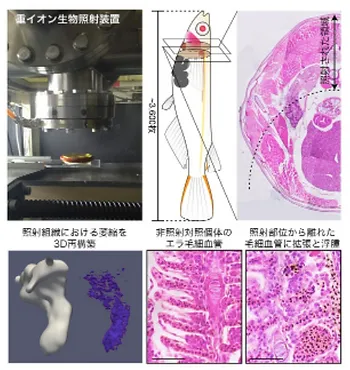 Figure 1
 Figure 2
 Figure 3
 Figure 4