
(Hepatocellular Carcinoma) FGF 401 New Drug Information
Medical Supporter — Information Notice
This article is a summary of international medical information and is not medical advice; it cannot replace the diagnosis or treatment plan of your attending physician. The medical technologies, drug information and clinical data presented here are compiled from public literature and official statements of major Japanese medical institutions; the applicability and outcome of any therapy vary with each patient and must be assessed individually by a qualified physician.
We are sharing drug information on the FGFR4 (Fibroblast Growth Factor Receptor 4) inhibitor FGF 401, with Phase 1/2 dose-escalation trial results now available for FGFR4/KLB-positive hepatocellular carcinoma and other solid tumors. This was presented by Dr. Stephen L. Chan of The Chinese University of Hong Kong (currently at Prince of Wales Hospital in China) at the AACR Annual Meeting held in Washington D.C. from April 1–5, 2017.
The report indicated that FGFR4 and Klotho β (KLB) found in hepatocytes, when bound to FGF19, can suppress CYP7A1 and regulate bile acid synthesis in cholesterol. A subtype of hepatocellular carcinoma was found to have abnormalities in FGF19/FGFR4 signaling. Therefore, FGF 401, by inhibiting FGFR4, is expected to be effective against hepatocellular carcinoma.
The initial experiment addressed safety, toxicity, maximum tolerated dose, and safe dosing, with designs evaluating timing (fasting vs. fed). Dosing was once daily: fasting doses of 50 mg, 80 mg, 120 mg, and 150 mg; fed doses of 80 mg and 120 mg. Additional assessments included FGFR4 and KLB quantification from tumor specimens by RT-qPCR and biochemical tests before and after treatment.
In Phase 1, 68 patients were consulted. Median age was 61.0 years (23–80 years); 80.9% male; 55.9% Asian, 41.2% White; 79.4% with primary hepatocellular carcinoma.
In approximately 20% or more of patients, the following were observed: diarrhea (71%), elevated AST (56%), elevated ALT (51%), elevated blood bilirubin (29%), loss of appetite (26%), skin itching (21%). About 5% experienced Grade 3/4 adverse events, including elevated AST (25%), elevated ALT (16%), ascites (10%), elevated blood bilirubin, elevated gamma-GT, hyponatremia, and dyspnea (each 6%). Most were Grade 1/2 adverse events.
As of January 31, 2017, among the 54 hepatocellular carcinoma patients enrolled in Phase 1 clinical trials, the objective response rate was 7.4% and the disease control rate was 59.3%. The median time to progression was 4.2 months.
For drug information, please refer to: https://newdrugapprovals.org/2017/04/13/fgf-401/
For the clinical trial, please refer to: https://clinicaltrials.gov/ct2/show/NCT02325739
Medical Supporter was formerly certified as an international medical visa guarantor by Japan's Ministry of Foreign Affairs and the Ministry of Economy, Trade and Industry (B-066).
Considering medical care in Japan? Need information and support?
We help you organize the information needed for medical travel to Japan, liaise with Japanese medical institutions, and arrange a second-opinion consultation.The first consultation is free; an advisor will help you clarify the next steps.
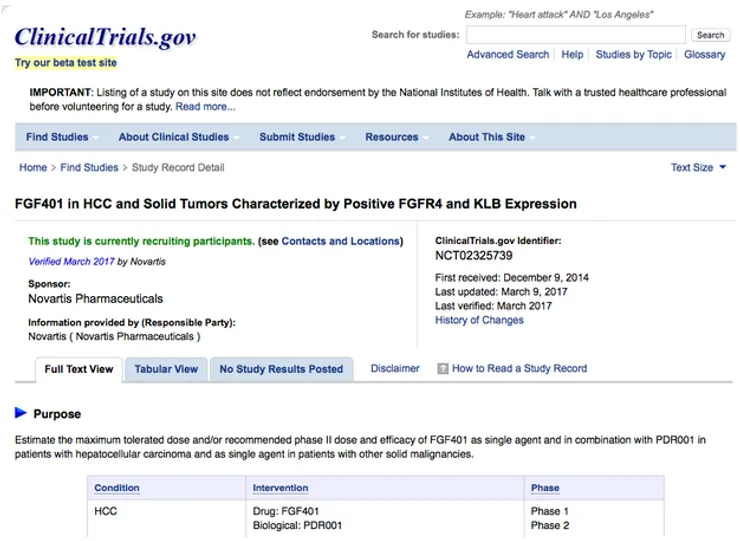 Figure 1
 Figure 2
 Figure 3
 Figure 4