
(Lymphoma) Is Odronextamab Effective?
Medical Supporter — Information Notice
This article is a summary of international medical information and is not medical advice; it cannot replace the diagnosis or treatment plan of your attending physician. The medical technologies, drug information and clinical data presented here are compiled from public literature and official statements of major Japanese medical institutions; the applicability and outcome of any therapy vary with each patient and must be assessed individually by a qualified physician.
- January 24, 2023
- Read time: 2 minutes
From December 10–13, 2022, Won-Seog Kim and colleagues from Samsung Medical Center presented results from the ELM-2 Phase 2 clinical trial evaluating the efficacy and safety of Odronextamab in previously treated relapsed/refractory diffuse large B-cell lymphoma (DLBCL) patients at the ASH 2022 Annual Meeting in New Orleans, Louisiana, USA.
The ELM-2 Phase 2 clinical trial was conducted jointly at multiple international facilities. Previously treated relapsed/refractory DLBCL patients received Odronextamab therapy (21-day treatment cycles: Cycle 1 Day 1: 0.2 mg, Day 2: 0.5 mg, Days 8–9: 2 mg each, Days 15–16: 10 mg each; Cycles 2–4 Days 1, 8, 15: 160 mg), then maintenance therapy at 320 mg on Day 1 every two-week cycle until intolerable adverse events occurred. The primary endpoint was objective response rate.
Patient characteristics: median age 67 years (range 24–88); 60% male; 80% classified as Stage III–IV per Ann Arbor classification; 58% with IPI score ≥3; median number of prior treatments was 2 (range 2–8).
At a median follow-up of 17.1 months, among 90 evaluable patients, the primary endpoint objective response rate was 53% (N=48/90), with complete response rate of 37% (N=33/90). The median complete response duration was not reached; the 9-month complete response rate was 73%.
Regarding safety, overall adverse event incidence was 84% (N=102). Adverse events confirmed in ≥30% of patients included cytokine release syndrome (CRS) 53%, fever 41%, and anemia 34%. Mild CRS rates were 35% and 13% respectively. Two patients experienced Grade 5 or higher adverse events, and eight patients discontinued treatment due to adverse events.
Based on the ELM-2 trial results, Won-Seog Kim and colleagues concluded: Odronextamab therapy demonstrated clinically meaningful antitumor activity in relapsed/refractory DLBCL patients with good patient tolerability to adverse events.
Source: https://ash.confex.com/ash/2022/webprogram/Paper158406.html
- Clinical Trial Medications
Medical Supporter was formerly certified as an international medical visa guarantor by Japan's Ministry of Foreign Affairs and the Ministry of Economy, Trade and Industry (B-066).
Considering medical care in Japan? Need information and support?
We help you organize the information needed for medical travel to Japan, liaise with Japanese medical institutions, and arrange a second-opinion consultation.The first consultation is free; an advisor will help you clarify the next steps.
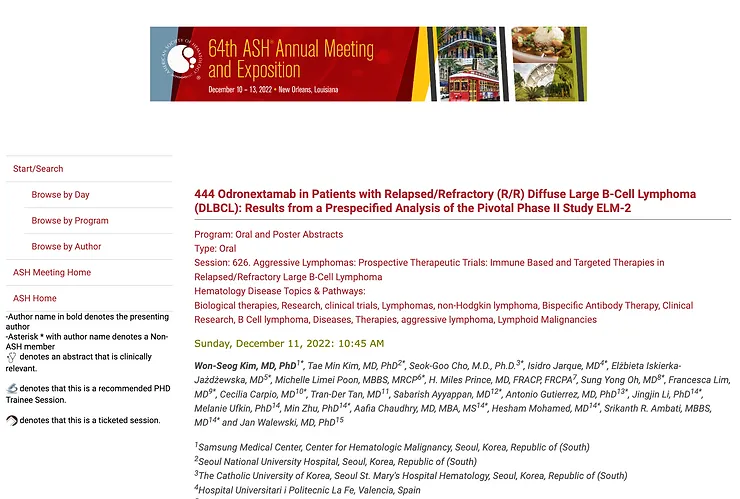 Figure 1
 Figure 2
 Figure 3
 Figure 4