
Sacituzumab Govitecan in Pretreated HR+/HER2- Breast Cancer: TROPiCS-02 Trial
Medical Supporter — Information Notice
This article is a summary of international medical information and is not medical advice; it cannot replace the diagnosis or treatment plan of your attending physician. The medical technologies, drug information and clinical data presented here are compiled from public literature and official statements of major Japanese medical institutions; the applicability and outcome of any therapy vary with each patient and must be assessed individually by a qualified physician.
Medical Supporter — Information Notice
This article is a summary of international medical information and is not medical advice; it cannot replace the diagnosis or treatment plan of your attending physician. The medical technologies, drug information and clinical data presented here are compiled from public literature and official statements of major Japanese medical institutions; the applicability and outcome of any therapy vary with each patient and must be assessed individually by a qualified physician.
On August 26, 2022, Hope S. Rugo and colleagues from the UCSF Helen Diller Family Comprehensive Cancer Center published the primary results of the TROPiCS-02 Phase 3 clinical trial in the Journal of Clinical Oncology. The study investigated the efficacy and safety of Sacituzumab govitecan (Trodelvy) in patients with hormone receptor-positive (HR+) and HER2-negative metastatic breast cancer who had progressed after endocrine therapy and CDK4/6 inhibitors.
Study Design: TROPiCS-02 Trial
This international, multicenter, randomized trial enrolled 543 patients with heavily pretreated HR+/HER2- metastatic breast cancer (median of 3 prior therapies). Participants were randomized to receive:
- Sacituzumab govitecan Group (N=272): 10 mg/kg on days 1 and 8 of a 21-day cycle.
- Chemotherapy Group (N=271): Physician's choice of chemotherapy (Eribulin, Capecitabine, Gemcitabine, or Vinorelbine).
The primary endpoint was progression-free survival (PFS).
Key Results
The trial achieved its primary objective, demonstrating a statistically significant improvement in PFS:
- Median PFS: 5.5 months for the Sacituzumab govitecan group vs. 4.0 months for the chemotherapy group (Hazard Ratio [HR] = 0.66).
- PFS Rates:
- 6-Month PFS: 46% (Sacituzumab govitecan) vs. 30% (Chemotherapy).
- 12-Month PFS: 21% (Sacituzumab govitecan) vs. 7% (Chemotherapy).
- Overall Survival (OS): An interim analysis showed a positive trend favoring Sacituzumab govitecan, which was later confirmed as statistically significant in subsequent updates.
Safety Profile
The incidence of Grade 3 or higher adverse events was 74% in the Sacituzumab govitecan group compared to 60% in the chemotherapy group. The most common Grade 3+ toxicities for Sacituzumab govitecan were neutropenia (51% vs. 38%) and diarrhea (9% vs. 1%).
Conclusion
The TROPiCS-02 results establish Sacituzumab govitecan as an important new treatment option for patients with pretreated HR+/HER2- metastatic breast cancer who have limited choices after failing CDK4/6 inhibitors and multiple lines of endocrine therapy.
Source: Journal of Clinical Oncology - TROPiCS-02 Results
#BreastCancer #HRPositive #SacituzumabGovitecan #Trodelvy #TROPiCS02 #CancerResearch #ADC
Considering medical care in Japan? Need information and support?
We help you organize the information needed for medical travel to Japan, liaise with Japanese medical institutions, and arrange a second-opinion consultation.The first consultation is free; an advisor will help you clarify the next steps.
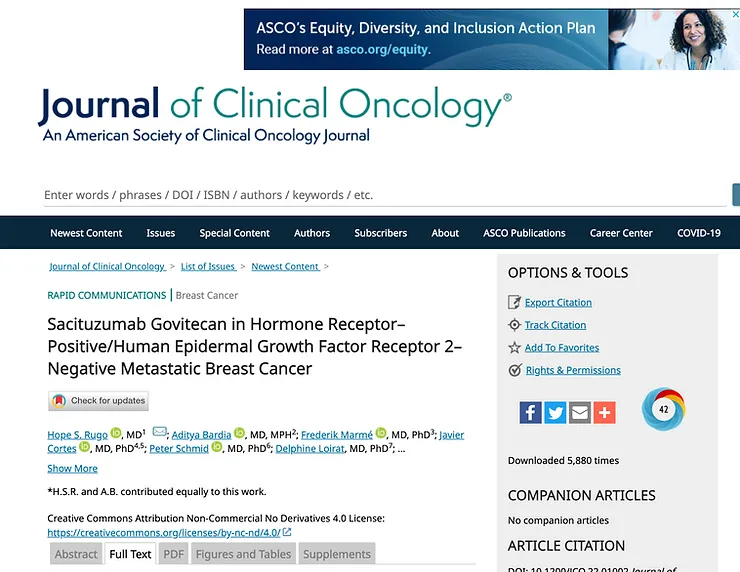 Figure 1
 Figure 2
 Figure 3
 Figure 4