
FDA Approves Belzutifan for VHL-Associated Cancers
Medical Supporter — Information Notice
This article is a summary of international medical information and is not medical advice; it cannot replace the diagnosis or treatment plan of your attending physician. The medical technologies, drug information and clinical data presented here are compiled from public literature and official statements of major Japanese medical institutions; the applicability and outcome of any therapy vary with each patient and must be assessed individually by a qualified physician.
Medical Supporter — Information Notice
This article is a summary of international medical information and is not medical advice; it cannot replace the diagnosis or treatment plan of your attending physician. The medical technologies, drug information and clinical data presented here are compiled from public literature and official statements of major Japanese medical institutions; the applicability and outcome of any therapy vary with each patient and must be assessed individually by a qualified physician.
On August 13, 2021, the U.S. Food and Drug Administration (FDA) approved Belzutifan (Welireg) for adult patients with Von Hippel-Lindau (VHL) disease who require therapy for associated renal cell carcinoma (RCC), central nervous system (CNS) hemangioblastomas, or pancreatic neuroendocrine tumors (pNET), not requiring immediate surgery.
Clinical Evidence: Study 004
The approval was based on results from Study 004 (NCT03401788), an open-label trial involving 61 patients with VHL-associated RCC who had at least one measurable solid tumor. The trial also evaluated patients with other VHL-associated tumors, including CNS hemangioblastomas and pNETs.
Patients received 120 mg of Belzutifan orally once daily until disease progression or unacceptable toxicity.
Key Efficacy Results (18-Month Follow-up)
- VHL-Associated RCC:
- Objective Response Rate (ORR): 49%
- Duration of Response (DOR): Median not reached; 56% of responders had a response lasting 12 months or longer.
- Median Time to Response: 8 months.
- VHL-Associated CNS Hemangioblastomas (N=24): ORR was 63% (73% had DOR ≥ 12 months).
- VHL-Associated Pancreatic Neuroendocrine Tumors (N=12): ORR was 83% (50% had DOR ≥ 12 months).
Safety and Side Effects
The most common adverse reactions (incidence ≥ 20%) included decreased hemoglobin, anemia, fatigue, increased creatinine, headache, dizziness, increased glucose, and nausea.
Important Safety Warnings:
- Anemia: 90% of patients experienced anemia, with 7% experiencing Grade 3. Blood transfusions may be required. Erythropoiesis-stimulating agents (ESAs) are not recommended.
- Hypoxia: Occurred in 1.6% of patients.
- Reproductive Risk: Belzutifan may reduce the efficacy of some hormonal contraceptives and can cause fetal harm during pregnancy.
Dosage and Administration
The recommended dosage is 120 mg orally once daily, taken with or without food.
Source: FDA - Belzutifan Approval for VHL-Associated Cancers
#RenalCellCarcinoma #VHLDisease #Belzutifan #Welireg #CancerTreatment #FDAApproval
Considering medical care in Japan? Need information and support?
We help you organize the information needed for medical travel to Japan, liaise with Japanese medical institutions, and arrange a second-opinion consultation.The first consultation is free; an advisor will help you clarify the next steps.
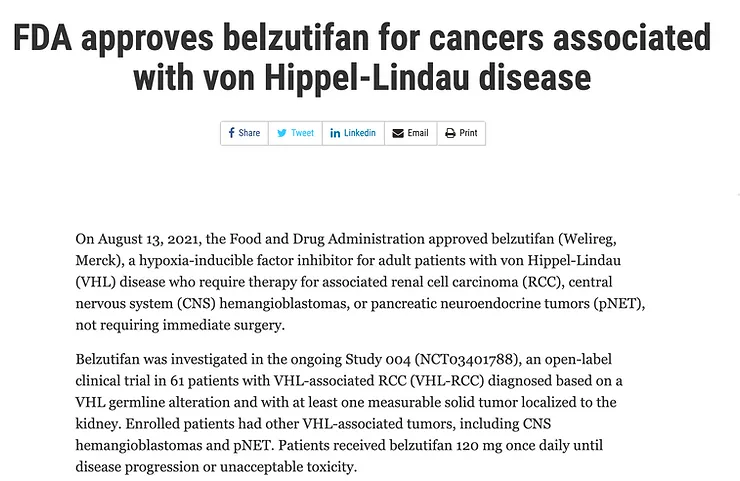 Figure 1
 Figure 2
 Figure 3
 Figure 4