
FDA Approves Tecartus for Relapsed or Refractory B-Cell Precursor ALL
Medical Supporter — Information Notice
This article is a summary of international medical information and is not medical advice; it cannot replace the diagnosis or treatment plan of your attending physician. The medical technologies, drug information and clinical data presented here are compiled from public literature and official statements of major Japanese medical institutions; the applicability and outcome of any therapy vary with each patient and must be assessed individually by a qualified physician.
Medical Supporter — Information Notice
This article is a summary of international medical information and is not medical advice; it cannot replace the diagnosis or treatment plan of your attending physician. The medical technologies, drug information and clinical data presented here are compiled from public literature and official statements of major Japanese medical institutions; the applicability and outcome of any therapy vary with each patient and must be assessed individually by a qualified physician.
On October 1, 2021, the U.S. Food and Drug Administration (FDA) approved Tecartus (brexucabtagene autoleucel) for the treatment of adult patients with relapsed or refractory B-cell precursor acute lymphoblastic leukemia (ALL).
Clinical Evidence: ZUMA-3 Trial
The approval was supported by the ZUMA-3 (NCT02614066) trial, a multicenter, single-arm study. Adult patients with relapsed or refractory B-cell precursor ALL received a single infusion of Tecartus following lymphodepleting chemotherapy.
Efficacy Results
The primary efficacy endpoint was the rate of complete remission (CR) within three months of infusion and the duration of that remission.
- Analysis Set: 54 evaluable patients.
- Complete Remission Rate: 52% (28 patients) achieved CR within three months.
- Duration of Response: With a median follow-up of 7.1 months, the median DOR was not reached; however, approximately half of the responders were estimated to maintain CR for over 12 months.
Safety and Side Effects
Tecartus carries a boxed warning for Cytokine Release Syndrome (CRS) and neurological toxicities.
- CRS Incidence: 92%
- Neurological Toxicity Incidence: 87%
Common Adverse Reactions (incidence ≥ 20%): Fever, CRS, hypotension, encephalopathy, tachycardia, nausea, chills, headache, fatigue, febrile neutropenia, diarrhea, musculoskeletal pain, hypoxia, rash, edema, tremor, infection, constipation, decreased appetite, and vomiting.
Dosage and Administration
The recommended dose is a single intravenous infusion of 1 x 10⁶ CAR-positive T cells per kg of body weight (up to a maximum of 1 x 10⁸ cells), administered after lymphodepleting chemotherapy.
Source: FDA - Tecartus Approval for Adult ALL
#Leukemia #ALL #CAR_T #Tecartus #Immunotherapy #FDAApproval
Considering medical care in Japan? Need information and support?
We help you organize the information needed for medical travel to Japan, liaise with Japanese medical institutions, and arrange a second-opinion consultation.The first consultation is free; an advisor will help you clarify the next steps.
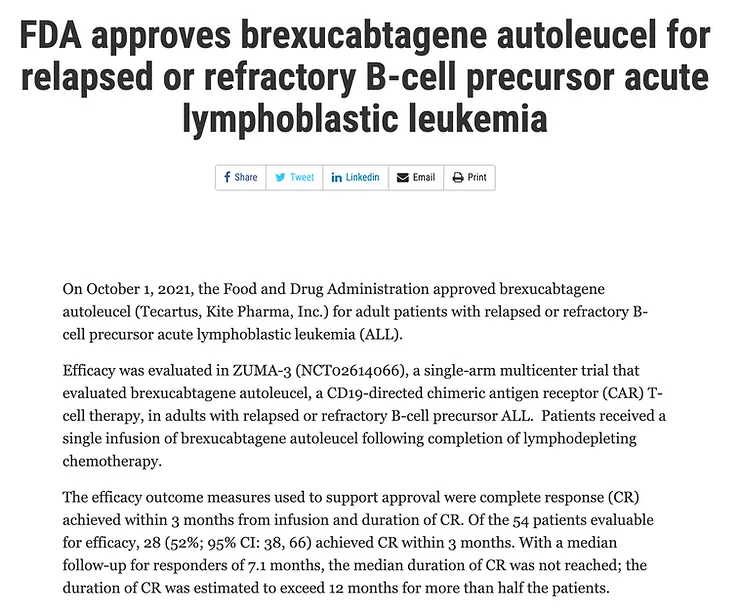 Figure 1
 Figure 2
 Figure 3
 Figure 4