
FDA Approves Rylaze for Patients with Leukemia Experiencing Allergic Reactions to Asparaginase Treatment
FDA Approves Rylaze for Patients with Leukemia Experiencing Allergic Reactions to Asparaginase Treatment
Medical Supporter — Information Notice
This article is a summary of international medical information and is not medical advice; it cannot replace the diagnosis or treatment plan of your attending physician. The medical technologies, drug information and clinical data presented here are compiled from public literature and official statements of major Japanese medical institutions; the applicability and outcome of any therapy vary with each patient and must be assessed individually by a qualified physician.
Medical Supporter — Information Notice
This article is a summary of international medical information and is not medical advice; it cannot replace the diagnosis or treatment plan of your attending physician. The medical technologies, drug information and clinical data presented here are compiled from public literature and official statements of major Japanese medical institutions; the applicability and outcome of any therapy vary with each patient and must be assessed individually by a qualified physician.
Formerly certified by Japan's Ministry of Foreign Affairs — Medical Visa Guarantee Authority B-66 Travel Service Arrangement Business License No. 35, Fukuoka Prefecture, Japan Japan Medical Device Sales and Rental Business
Formerly certified by Japan's Ministry of Foreign Affairs — Medical Visa Guarantee Authority B-66 Travel Service Arrangement Business License No. 35, Fukuoka Prefecture, Japan Japan Medical Device Sales and Rental Business
FDA Approves Rylaze for Patients with Leukemia Experiencing Allergic Reactions to Asparaginase Treatment
On June 30, 2021, the U.S. Food and Drug Administration (FDA) approved Rylaze for use in combination with multiple chemotherapy drugs for patients with acute lymphoblastic leukemia and lymphoblastic lymphoma who experienced allergic reactions to asparaginase treatment.
This approval was based on the evaluation from the JZP458-201 (NCT04145531) trial, a multicenter, non-blinded, open-label trial. Asparaginase is one of the agents used in combination with multiple chemotherapy regimens for patients with acute lymphoblastic leukemia and lymphoblastic lymphoma. In this trial, 102 patients who experienced allergic reactions to asparaginase were treated with Rylaze via intramuscular injection, with a median age of 10 years (ranging from 1 to 24 years).
The primary endpoint was serum asparaginase activity (ASP) increasing from the nadir by at least 0.1 U/mL and being maintained. Trial results and simulation data showed that approximately 93.6% of patients achieved serum ASP ≥0.1 U/mL 48 hours after intramuscular injection of Rylaze 25 mg/m² every 48 hours.
The main adverse effects of Rylaze (occurring in ≥20% of patients) include abnormal liver function, nausea, musculoskeletal pain, fatigue, infection, headache, fever, drug allergies, febrile neutropenia, loss of appetite, stomatitis, bleeding, and hyperglycemia.
When switching from long-acting asparaginase to Rylaze, it is recommended to administer Rylaze 25 mg/m² via intramuscular injection every 48 hours to maintain asparaginase activity.
This website uses cookies to understand how you interact with it. By accepting, you agree to our use of cookies. Privacy Policy
Medical Supporter was formerly certified as an international medical visa guarantor by Japan's Ministry of Foreign Affairs and the Ministry of Economy, Trade and Industry (B-066).
Considering medical care in Japan? Need information and support?
We help you organize the information needed for medical travel to Japan, liaise with Japanese medical institutions, and arrange a second-opinion consultation.The first consultation is free; an advisor will help you clarify the next steps.
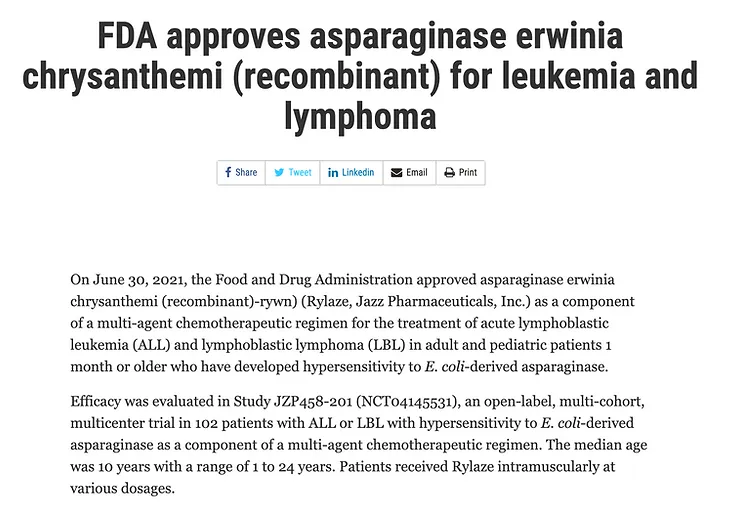 Figure 1
 Figure 2
 Figure 3
 Figure 4