FDA Approves Rylaze for Patients with Leukemia Experiencing Allergic Reactions to Asparaginase Treatment
Medical Supporter — Avis d’information
Cet article est une synthèse d’informations médicales internationales et ne constitue pas un avis médical ; il ne remplace pas le diagnostic ni le plan de traitement de votre médecin traitant. Les informations présentées sont compilées à partir de publications publiques et de déclarations officielles d’établissements médicaux japonais ; l’adéquation et les résultats de toute thérapie varient selon chaque patient et doivent être évalués individuellement par un médecin qualifié.
Formerly certified by Japan's Ministry of Foreign Affairs — Medical Visa Guarantee Authority B-66 Travel Service Arrangement Business License No. 35, Fukuoka Prefecture, Japan Japan Medical Device Sales and Rental Business
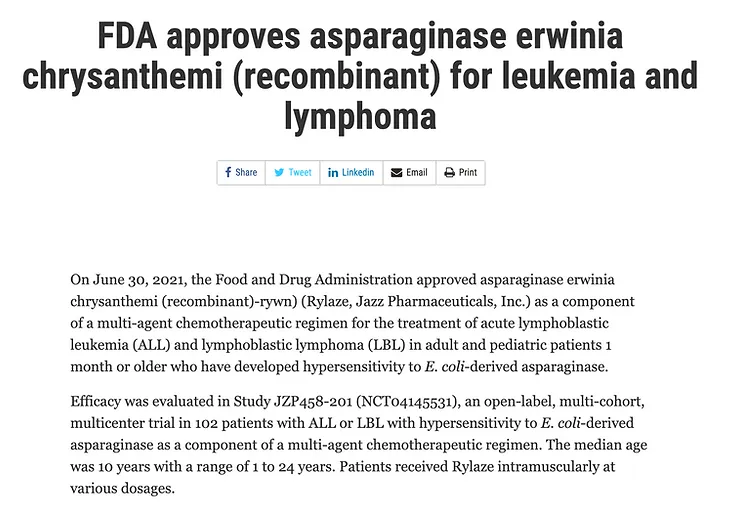
FDA Approves Rylaze for Patients with Leukemia Experiencing Allergic Reactions to Asparaginase Treatment
On June 30, 2021, the U.S. Food and Drug Administration (FDA) approved Rylaze for use in combination with multiple chemotherapy drugs for patients with acute lymphoblastic leukemia and lymphoblastic lymphoma who experienced allergic reactions to asparaginase treatment.
This approval was based on the evaluation from the JZP458-201 (NCT04145531) trial, a multicenter, non-blinded, open-label trial. Asparaginase is one of the agents used in combination with multiple chemotherapy regimens for patients with acute lymphoblastic leukemia and lymphoblastic lymphoma. In this trial, 102 patients who experienced allergic reactions to asparaginase were treated with Rylaze via intramuscular injection, with a median age of 10 years (ranging from 1 to 24 years).
The primary endpoint was serum asparaginase activity (ASP) increasing from the nadir by at least 0.1 U/mL and being maintained. Trial results and simulation data showed that approximately 93.6% of patients achieved serum ASP ≥0.1 U/mL 48 hours after intramuscular injection of Rylaze 25 mg/m² every 48 hours.
The main adverse effects of Rylaze (occurring in ≥20% of patients) include abnormal liver function, nausea, musculoskeletal pain, fatigue, infection, headache, fever, drug allergies, febrile neutropenia, loss of appetite, stomatitis, bleeding, and hyperglycemia.
When switching from long-acting asparaginase to Rylaze, it is recommended to administer Rylaze 25 mg/m² via intramuscular injection every 48 hours to maintain asparaginase activity.
Copyright© 2015 Shingihou Co., Ltd. All rights reserved.
Medical Supporter was formerly certified as a medical visa guarantor by Japan's Ministry of Foreign Affairs and the Ministry of Economy, Trade and Industry (B-066).
Vous envisagez des soins au Japon ? Besoin d’informations et d’aide ?
Nous vous aidons à rassembler les informations nécessaires pour un déplacement médical au Japon, à contacter les établissements japonais et à organiser une consultation de second avis.La première consultation est gratuite ; un conseiller vous aide à clarifier les prochaines étapes.
Figure 1
Figure 2
Figure 3
Figure 4