Heavy Ion & Proton Beam Therapy
Heavy Ion / Proton Beam Therapy
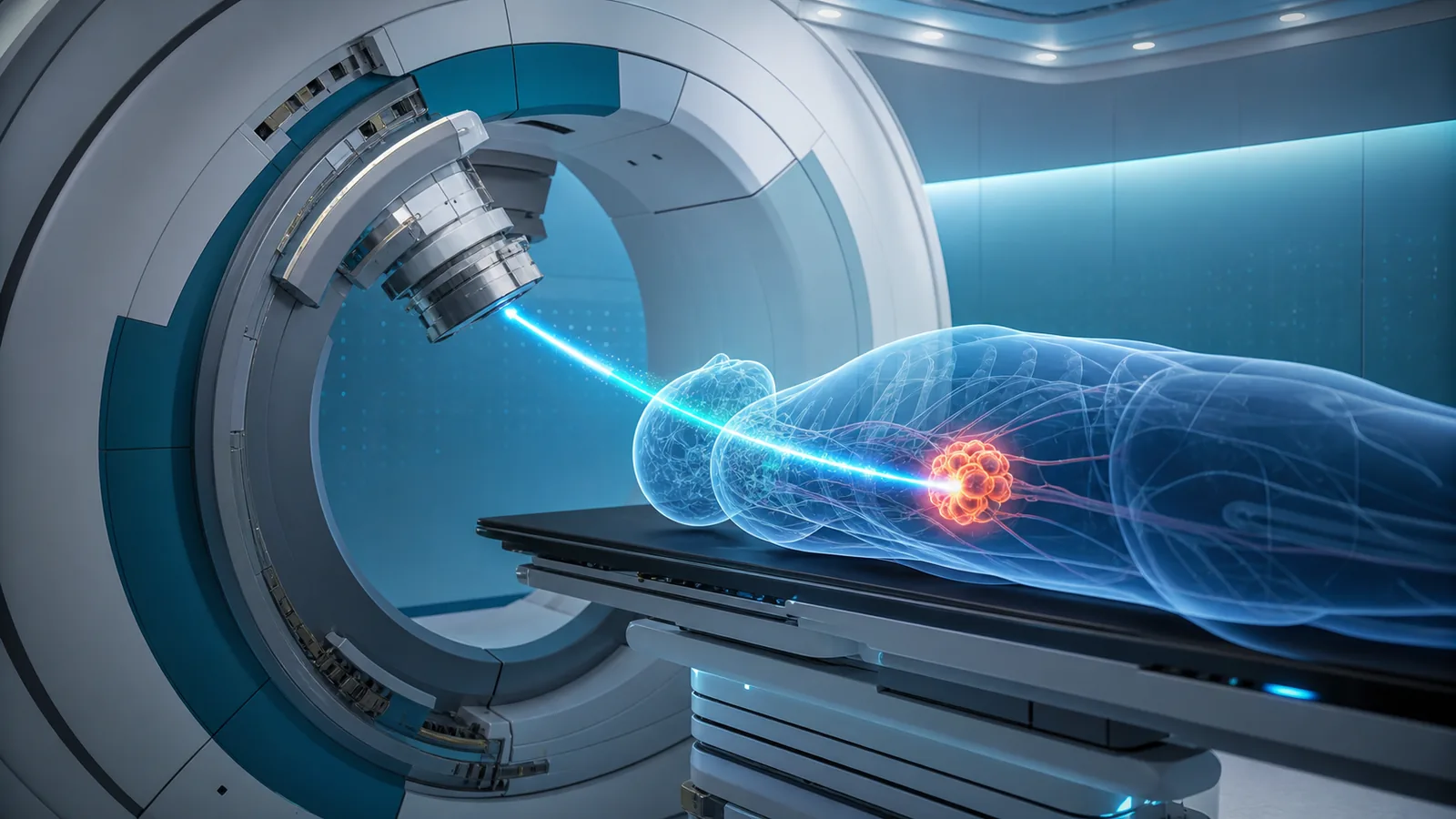
Heavy-ion and proton therapy use particle beams that release energy at tumor depth and are often evaluated as advanced radiation options for selected solid tumors. Suitability, treatment length and risks must be determined by Japanese specialists from records and imaging.
What is Heavy Ion & Proton Therapy?
The Bragg Peak
Unlike X-rays that penetrate the entire body, particle beams (proton or heavy ion) release very little energy upon entry. Only when they reach the predetermined tumor depth does the energy concentrate at the planned depth
Biological Advantages of Heavy Ions
Heavy ions (carbon ions) possess higher Linear Energy Transfer (LET) than protons. They directly cause a higher likelihood of double-strand DNA damage
Radiation Therapy Technology Comparison
Photon (X-ray / Gamma)
- Physical propertyEnergy decreases with depth, penetrates through
- Cell damagePrimarily single-strand DNA damage
- PrecisionModerate, damages normal tissue
- Best forWidely used, more side effects
Proton
- Physical propertyPrecise Bragg Peak release
- Cell damageModerate DNA damage capability
- PrecisionHigh, protects surrounding tissue
- Best forPreferred for head & neck, pediatric cancers
Heavy Ion
- Physical propertyBragg Peak + high LET
- Cell damageHigher-LET DNA damage
- PrecisionExtremely high, minimal scattering
- Best forRefractory, treatment-resistant cancers
7 Major Cancer Indications
Head & Neck Tumors
Includes nasopharyngeal, paranasal sinus, and oral cancers — precise targeting that avoids the eyes and optic nerves.
Lung Cancer
Especially Stage I non-small cell lung cancer — early-stage completion in just 1–4 sessions.
Liver Cancer
For inoperable or RFA-unsuitable liver cancer, effectively preserves normal liver function.
Prostate Cancer
Some prostate cancer cases may be evaluated for particle therapy; treatment length and urinary or bowel side-effect risks must be explained by physicians based on imaging and staging.
Bone & Soft Tissue Sarcoma
Significant efficacy for X-ray-resistant chordoma, chondrosarcoma, and similar tumors.
Pancreatic Cancer
For locally advanced pancreatic cancer — combined with chemotherapy to improve resection rates and survival.
Cervical Cancer
Provides new treatment options for locally advanced cervical adenocarcinoma and other difficult types.
And more...
Particle therapy is also used for uveal melanoma, certain recurrent cancers, and more. Contact us for a case-by-case assessment.
4 Steps, Precise and Orderly
Records Review & Initial Assessment
Submit medical records, imaging data (DICOM), and biopsy reports for Japanese experts to assess eligibility.
First Visit to Japan for Examination
Travel to the Japanese hospital for precision PET/CT, MRI imaging, and face-to-face diagnosis by the attending physician.
Custom Fixation & Treatment Planning
Custom immobilization molds are created and 3D/4D simulation with dose distribution calculations are performed.
Outpatient Treatment & Follow-up
One session per day, about 5 times per week. The process is painless and doesn't require hospitalization, with regular follow-up after treatment.
Comparison of Japan's Top Particle Therapy Centers
QST Hospital (Chiba)
- World's #1 heavy-ion treatment volume
- 28-member team of heavy-ion specialists
- 100 inpatient beds available
- Supports respiratory gating and rotational irradiation
SAGA HIMAT (Saga)
- Carbon-ion radiation therapy equipment
- Indications reviewed by radiation oncologists
- Planning based on records and imaging
- Convenient access from Shinkansen Tosu Station
MediProton (Kagoshima)
- Proton radiation therapy equipment
- Suitability reviewed by cancer type and stage
- Treatment experience and risks explained by the hospital in advance
- Evaluation focus for selected early-stage solid tumors
Precautions & Treatment Limitations
Particle therapy is powerful but not suitable for all cancers or conditions:
- Systemic blood cancers like leukemia
- Patients with extensive, multi-site metastases
- Previously irradiated sites
- Luminal organs (stomach, colon) adjacent to the tumor
- Patients unable to maintain stable positioning
- Patients with very short expected survival
QST Hospital
Global authority on heavy-ion radiation therapy, equipped with the core HIMAC facility.
4-9-1 Anagawa, Inage-ku, Chiba City, Chiba Prefecture
SAGA HIMAT
Kyushu's first heavy-ion center with advanced technology and serene environment.
415-1 Hara-machi, Tosu City, Saga Prefecture
MediProton Center
Leading international proton therapy center, offering warm and attentive international services.
4313-28 Higashi, Ibusuki City, Kagoshima Prefecture
Four common concerns — and honest answers
Specific answers depend on your medical record and your attending physician. We ensure language is not a barrier to your understanding.
Q1Will it hurt?
Pain depends on the person and the procedure. Japanese hospitals follow a complete pain-management workflow: pre-procedure assessment, intra-procedural anaesthesia, and post-procedural pain control. You can ask your attending physician about expected pain at the pre-procedure briefing — our interpreter will translate question and answer accurately.
Q2How serious are the side effects?
Side effects differ by therapy. Before you sign consent, Japanese hospitals will walk you through the possible side effects, their probability, and how they are managed. If anything is unclear, we will ask the physician to re-explain until you fully understand before signing.
Q3How long is the hospital stay?
It depends on the therapy. Day treatments require no admission; some therapies need 1–3 days of observation; surgery or particle therapy may need 1–3 weeks. Your physician will note the duration in the treatment plan, and we translate the plan for you and your family.
Q4How soon after treatment can I fly home?
Day treatments and outpatient therapies usually allow same-day or next-day flights. For therapies with hospitalisation, you typically observe for 2–3 days post-discharge, and your physician issues a fitness-to-fly note. We help you book a flexible return ticket.
This section is general guidance. Specific expectations, suitability, and timing must be determined by your attending physician in Japan based on your complete medical record.
Medical information disclaimer
The information on this page is for educational reference only and does not constitute medical advice. The suitability, side effects, and expected outcomes of any therapy must be determined by your attending physician in Japan based on your complete medical record. Medical Supporter does not replace any professional medical judgement.
First Confirm Whether Particle Therapy Fits Your Case
We help organize records, translate documents, contact hospitals, and arrange professional interpreter accompaniment in Japan. Eligibility for particle therapy must be assessed by Japanese medical institutions based on imaging, pathology, and overall condition.