Full detail content for this treatment is being translated. For a localized consultation in English, please contact our coordinators — we respond within 24 hours.
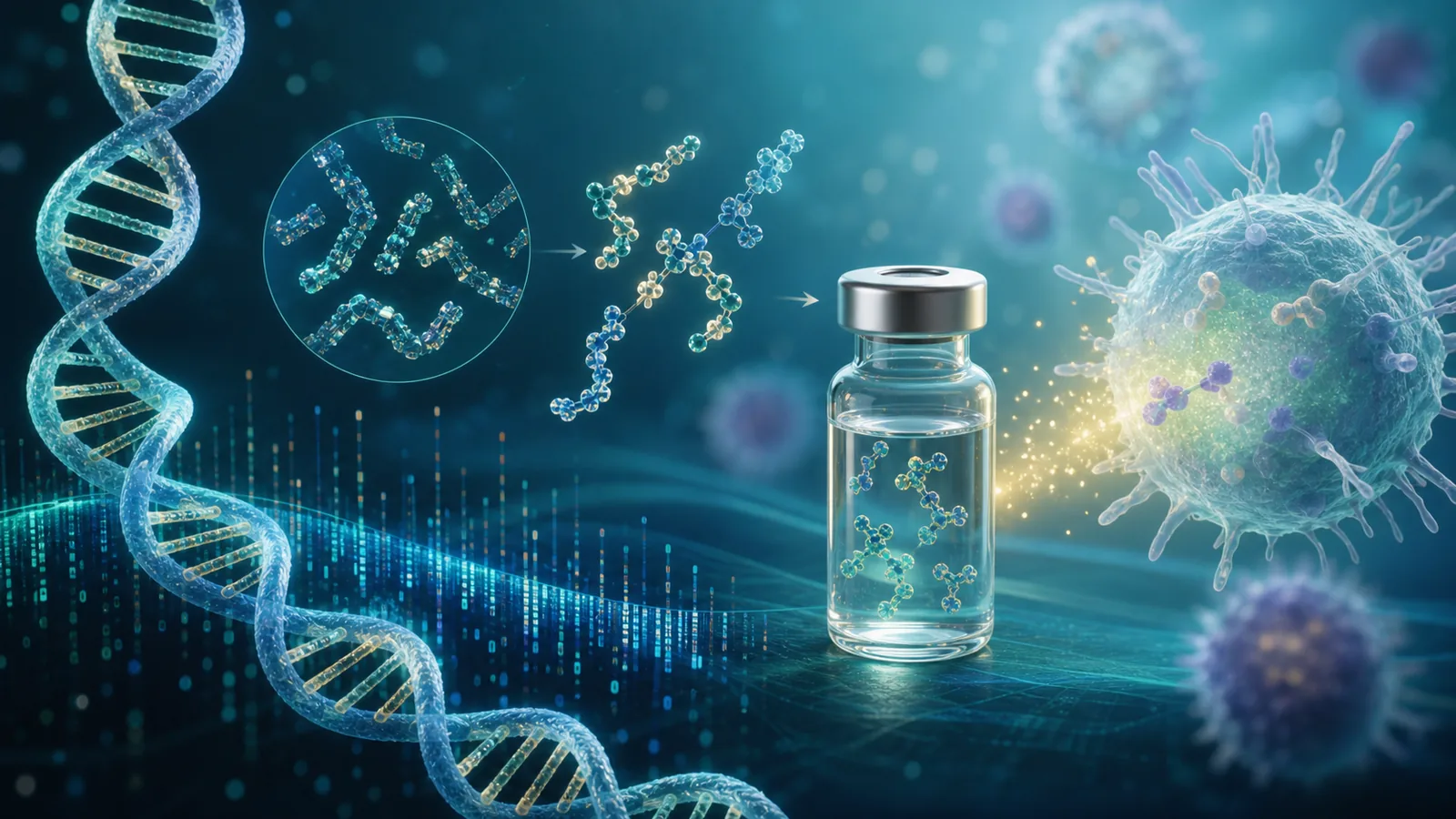
Neoantigen Personalized Vaccine
A one-of-a-kind prescription for each patient
NEO Clinic Tokyo (academic partner: IMSUT, University of Tokyo) combines next-generation sequencing and AI to identify each patient's unique mutations — precisely hunting cancer cells and opening a new era of cancer immunotherapy.
Why a "Personalised" Cancer Vaccine?
The uniqueness of each tumour
Even for cancers of the same organ, tumour mutation profiles can differ from patient to patient. Neoantigen evaluation focuses oncancer-specific proteins。
The apex of precision medicine
By using NGS to find sites that exist only in cancer cells, treatmentminimizes damage to normal cells during treatment。
Six steps to your bespoke vaccine
Precision manufacturing combining genomics and AI
Tissue biopsy and blood sampling
Collect tumour tissue (surgical or needle biopsy) and blood, then extract cancer-cell DNA/RNA alongside healthy-cell DNA as a control.
Whole-genome sequencing (NGS)
Next-generation sequencing comprehensively compares tumour and normal tissue to identify mutation sites unique to cancer cells.
Mutation identification and screening
From thousands of mutations, select candidate neoantigen sites that produce altered proteins presented on the cell surface.
AI immunogenicity prediction
A proprietary AI algorithm simulates MHC-binding affinity and selects the 20–30 most representative antigens most likely to trigger T-cell attack.
Bespoke vaccine synthesis
Using AI output, peptide vaccines are chemically synthesised in a high-grade cell-processing centre (CPC), with quality-control and release checks under the preparation workflow.
Vaccination and immune monitoring
The vaccine is administered subcutaneously with adjuvants to activate the T-cell system, with periodic tracking of the anti-tumour immune response.
Why "a patient-specific prescription"?
Conventional / Standard cancer therapy
- ✕
Mass-market medication with no regard for individual genetic differences
- ✕
Pronounced side effects (hair loss, low white-cell counts, etc.)
- ✕
Drug resistance develops easily, driving recurrence
Personalised neoantigen vaccine
- ✓
Candidate antigens designed from tumour-mutation data
- ✓
Side effects and contraindications require physician explanation
- ✓
Use in recurrence-risk management requires case-by-case review
World-leading immuno-genomic technology
Next-generation sequencing (NGS)
Comprehensively maps the tumour genome, leaving no potential immune target overlooked.
Proprietary AI prediction algorithm
Models antigen-HLA binding to help shortlist candidate antigen combinations; actual immune response still requires clinical follow-up.
Dual MHC I/II presentation
Physicians may review MHC I/II presentation and immune-response information based on test data. Suitability must be determined by the medical institution.
Case-by-case review
Not an off-the-shelf drug — a fully bespoke prescription calibrated to each patient's tumour heterogeneity.
Academic research backing
Built on academic collaboration with the University of Tokyo Institute of Medical Science (IMSUT), translating cutting-edge research into clinical practice.
Physician-reviewed side-effect risk
Designed around tumour-specific neoantigens; expected reactions, contraindications, and combination risks should be explained by the physician for each case.
Dr. Lim Lay Ah Young, Director
Dr. Lim Lay Ah Young, M.D., Ph.D.
Professional background
- • Japanese specialist in medical oncology and immunotherapy
- • Expert in NGS genomic analysis and immune-system design
- • Collaborating researcher with the University of Tokyo IMSUT
- • Dedicated to translating academic research into clinical care
Treatment philosophy
"We no longer treat an illness called 'cancer' — we treat the one-of-a-kind mutation inside each patient. With sequencing and AI, we give the immune system precise coordinates, making medicine truly democratic."
Who it is for
All solid tumours
Including lung, gastric, pancreatic, liver, breast, colorectal, ovarian and other solid tumours.
Metastatic / recurrent cancers
A precision-targeted option for late-stage or metastatic patients whose disease is inoperable or has developed chemotherapy resistance.
Post-operative relapse prevention
Minimal residual disease (MRD) after surgery is a leading cause of recurrence; the vaccine empowers the immune system to keep round-the-clock watch.
A Japan–Asia precision-medicine alliance
NEO Clinic Tokyo
Precision medicine · Neoantigen specialist
A premium clinic in Shirokanedai focused on the clinical application of NGS and AI. A well-established international patient workflow delivers end-to-end care from first evaluation to vaccination.
Fukuoka Cancer Comprehensive Clinic
Fukuoka Cancer General Clinic uses neoantigen analysis and peptide selection in personalized approaches such as dendritic-cell vaccines. Specimens, testing and preparation requirements need clinic review. It also offers activated autologous lymphocyte therapy, distinct from Dojin Clinic’s six-cell combination.
View hospital detailsThe University of Tokyo Institute of Medical Science
Institute of Medical Science (IMSUT)
The University of Tokyo Institute of Medical Science is one of Japan’s major medical research institutions, with work in personalised cancer-vaccine research, clinical translation, and gene-related medicine. Clinical applicability still requires case-by-case review by the treating institution.
FAQ
What is a neoantigen?
Neoantigens are protein fragments that may arise from tumour mutations and can be recognised by the immune system. Whether they can be used as vaccine-design targets depends on genomic testing, HLA type, tumour heterogeneity, and physician interpretation.
Why is a personalised vaccine more effective than conventional cancer vaccines?
Conventional vaccines use generic antigens such as WT1, which not every patient carries. A personalised vaccine is designed around the patient's unique tumour mutations — extremely precise, and solves resistance caused by tumour heterogeneity.
How long does it take to make a personalised vaccine?
From sampling through NGS sequencing, AI analysis, and vaccine synthesis, the full workflow takes approximately 8–12 weeks. We recommend continuing standard care during the wait and then layering on immune enhancement once the vaccine is ready.
Is it suitable for every cancer?
This therapy applies to almost all solid tumours — lung, pancreatic, gastric, colorectal, breast, melanoma and more. It offers a new option for metastatic or treatment-refractory cancers.
Are there serious side effects during treatment?
Side effects and risks of a personalised vaccine must be assessed according to the patient’s condition, vaccine design, combined therapies, and immune status. Common reactions may include injection-site redness or fever, but suitability and management require physician review during informed consent.
Why choose the NEO Clinic Tokyo personalised-vaccine programme?
NEO Clinic Tokyo delivers leading precision-medicine services, and the programme combines research support and academic standing of the University of Tokyo Institute of Medical Science (IMSUT) — ensuring the core technology and AI algorithm sit on a deep scientific foundation.
Four common concerns — and honest answers
Specific answers depend on your medical record and your attending physician. We ensure language is not a barrier to your understanding.
Q1Will it hurt?
Pain depends on the person and the procedure. Japanese hospitals follow a complete pain-management workflow: pre-procedure assessment, intra-procedural anaesthesia, and post-procedural pain control. You can ask your attending physician about expected pain at the pre-procedure briefing — our interpreter will translate question and answer accurately.
Q2How serious are the side effects?
Side effects differ by therapy. Before you sign consent, Japanese hospitals will walk you through the possible side effects, their probability, and how they are managed. If anything is unclear, we will ask the physician to re-explain until you fully understand before signing.
Q3How long is the hospital stay?
It depends on the therapy. Day treatments require no admission; some therapies need 1–3 days of observation; surgery or particle therapy may need 1–3 weeks. Your physician will note the duration in the treatment plan, and we translate the plan for you and your family.
Q4How soon after treatment can I fly home?
Day treatments and outpatient therapies usually allow same-day or next-day flights. For therapies with hospitalisation, you typically observe for 2–3 days post-discharge, and your physician issues a fitness-to-fly note. We help you book a flexible return ticket.
This section is general guidance. Specific expectations, suitability, and timing must be determined by your attending physician in Japan based on your complete medical record.
Medical information disclaimer
The information on this page is for educational reference only and does not constitute medical advice. The suitability, side effects, and expected outcomes of any therapy must be determined by your attending physician in Japan based on your complete medical record. Medical Supporter does not replace any professional medical judgement.
Check whether a personalised vaccine fits your case
Personalised-vaccine evaluation usually requires pathology, imaging, genomic tests, and prior treatment records. Medical Supporter can translate records, organize imaging data, and contact Japanese medical institutions for feasibility review.