medical-blog
Dernière mise à jour: 2016-09-29

Olaparib plus Ceralasertib dans le cancer du sein triple négatif métastatique : Essai VIOLETTE

S
Équipe Medical Supporter
Équipe de coordination médicale internationale et de révision éditoriale
Olaparib plus Ceralasertib dans le cancer du sein triple négatif métastatique : Essai VIOLETTE

Olaparib Plus Ceralasertib in Metastatic Triple-Negative Breast Cancer: VIOLETTE Trial

Medical Supporter — Avis d’information

Cet article est une synthèse d’informations médicales internationales et ne constitue pas un avis médical ; il ne remplace pas le diagnostic ni le plan de traitement de votre médecin traitant. Les informations présentées sont compilées à partir de publications publiques et de déclarations officielles d’établissements médicaux japonais ; l’adéquation et les résultats de toute thérapie varient selon chaque patient et doivent être évalués individuellement par un médecin qualifié.

Tout plan de traitement précis doit être évalué par un médecin agréé au Japon

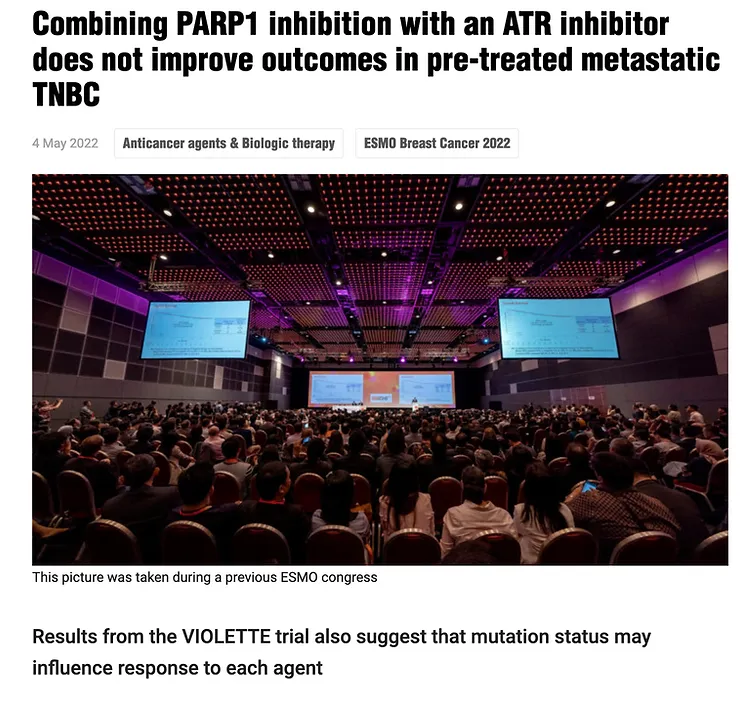
At the ESMO Breast Cancer Congress held in Berlin from May 3 to 5, 2022, results were presented for the VIOLETTE Phase 2 clinical trial. This study investigated the efficacy and safety of combining Olaparib (a PARP inhibitor) with Ceralasertib (an ATR inhibitor) in patients with previously treated metastatic triple-negative breast cancer (TNBC).

Study Design: VIOLETTE Trial

The VIOLETTE trial randomized patients with metastatic TNBC who had failed at least one prior line of therapy into two main arms:

  1. Olaparib Monotherapy
  2. Olaparib + Ceralasertib Combination

The primary endpoint was progression-free survival (PFS).

Key Results

The study results showed a modest numerical improvement in PFS with the combination, but the overall benefit remained limited:

  • Median PFS: 5.3 months for the Olaparib + Ceralasertib group vs. 3.6 months for the Olaparib monotherapy group.
  • Objective Response Rate (ORR):
    • BRCA Mutation Patients: 50.0% (Combination) vs. 44.2% (Monotherapy).
    • HRR Mutation Patients: 20.0% (Combination) vs. 15.0% (Monotherapy).
    • Non-HRR Mutation Patients: 15.4% (Combination) vs. 3.9% (Monotherapy).

While the combination showed some activity in patients without homologous recombination repair (HRR) mutations, it did not provide a significant clinical breakthrough for the broader population.

Safety Profile

Common adverse events included anemia and neutropenia. Grade 3 or higher adverse events occurred in 46.8% of patients in the combination group compared to 35.5% in the monotherapy group.

Conclusion

Dr. Suzette Delaloge from Institut Gustave Roussy noted that while basic research suggested synergy between PARP and ATR inhibition, the VIOLETTE trial did not demonstrate a substantial clinical benefit for pre-treated metastatic TNBC patients with BRCA mutations. However, the signals observed in patients without HRR mutations suggest that ATR inhibition may have independent antitumor activity worth further exploration.

Source: ESMO Daily Reporter - VIOLETTE Trial Highlights

#BreastCancer #TNBC #Olaparib #Ceralasertib #PARPInhibitor #ATRInhibitor #CancerResearch

Vous envisagez des soins au Japon ? Besoin d’informations et d’aide ?

Nous vous aidons à rassembler les informations nécessaires pour un déplacement médical au Japon, à contacter les établissements japonais et à organiser une consultation de second avis.La première consultation est gratuite ; un conseiller vous aide à clarifier les prochaines étapes.

Siège de Fukuoka : +81-92-984-3200
Anciennement certifié officiellement, n° B-066

Figure 1Figure 1

Figure 2Figure 2

Figure 3Figure 3

Figure 4Figure 4

Lectures complémentaires