
Olaparib Plus Ceralasertib in Metastatic Triple-Negative Breast Cancer: VIOLETTE Trial
Medical Supporter — إشعار معلوماتي
هذه المقالة ملخص لمعلومات طبية دولية وليست نصيحة طبية، ولا يمكن أن تحل محل تشخيص طبيبك المعالج أو خطة العلاج. المعلومات المعروضة مجمّعة من منشورات عامة وبيانات رسمية لكبرى المؤسسات الطبية اليابانية؛ وتختلف ملاءمة ونتائج أي علاج من مريض لآخر ويجب أن يقيّمها طبيب مؤهل لكل حالة على حدة.
Medical Supporter — إشعار معلوماتي
هذه المقالة ملخص لمعلومات طبية دولية وليست نصيحة طبية، ولا يمكن أن تحل محل تشخيص طبيبك المعالج أو خطة العلاج. المعلومات المعروضة مجمّعة من منشورات عامة وبيانات رسمية لكبرى المؤسسات الطبية اليابانية؛ وتختلف ملاءمة ونتائج أي علاج من مريض لآخر ويجب أن يقيّمها طبيب مؤهل لكل حالة على حدة.
At the ESMO Breast Cancer Congress held in Berlin from May 3 to 5, 2022, results were presented for the VIOLETTE Phase 2 clinical trial. This study investigated the efficacy and safety of combining Olaparib (a PARP inhibitor) with Ceralasertib (an ATR inhibitor) in patients with previously treated metastatic triple-negative breast cancer (TNBC).
Study Design: VIOLETTE Trial
The VIOLETTE trial randomized patients with metastatic TNBC who had failed at least one prior line of therapy into two main arms:
- Olaparib Monotherapy
- Olaparib + Ceralasertib Combination
The primary endpoint was progression-free survival (PFS).
Key Results
The study results showed a modest numerical improvement in PFS with the combination, but the overall benefit remained limited:
- Median PFS: 5.3 months for the Olaparib + Ceralasertib group vs. 3.6 months for the Olaparib monotherapy group.
- Objective Response Rate (ORR):
- BRCA Mutation Patients: 50.0% (Combination) vs. 44.2% (Monotherapy).
- HRR Mutation Patients: 20.0% (Combination) vs. 15.0% (Monotherapy).
- Non-HRR Mutation Patients: 15.4% (Combination) vs. 3.9% (Monotherapy).
While the combination showed some activity in patients without homologous recombination repair (HRR) mutations, it did not provide a significant clinical breakthrough for the broader population.
Safety Profile
Common adverse events included anemia and neutropenia. Grade 3 or higher adverse events occurred in 46.8% of patients in the combination group compared to 35.5% in the monotherapy group.
Conclusion
Dr. Suzette Delaloge from Institut Gustave Roussy noted that while basic research suggested synergy between PARP and ATR inhibition, the VIOLETTE trial did not demonstrate a substantial clinical benefit for pre-treated metastatic TNBC patients with BRCA mutations. However, the signals observed in patients without HRR mutations suggest that ATR inhibition may have independent antitumor activity worth further exploration.
Source: ESMO Daily Reporter - VIOLETTE Trial Highlights
#BreastCancer #TNBC #Olaparib #Ceralasertib #PARPInhibitor #ATRInhibitor #CancerResearch
هل تفكر في تلقّي العلاج في اليابان؟ هل تحتاج إلى معلومات ومساعدة؟
نساعدك في تنظيم المعلومات اللازمة للسفر الطبي إلى اليابان، والتواصل مع المؤسسات الطبية اليابانية، وترتيب استشارة رأي ثانٍ.الاستشارة الأولى مجانية؛ سيساعدك المستشار على توضيح الخطوات التالية.
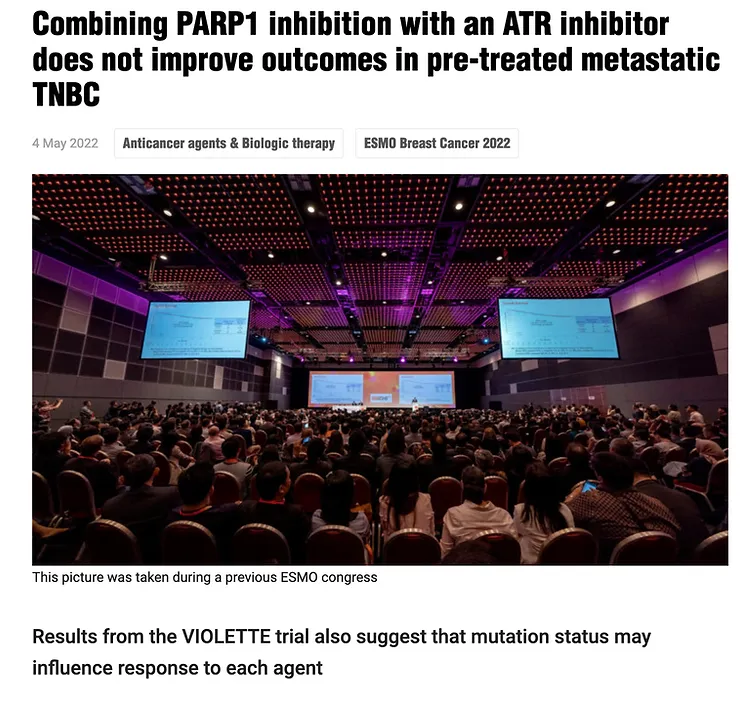 Figure 1
 Figure 2
 Figure 3
 Figure 4