
Keytruda in First-Line MSI-H/dMMR Metastatic Colorectal Cancer: KEYNOTE-177 Final Results
Medical Supporter — Thông báo thông tin
Bài viết này là bản tổng hợp thông tin y tế quốc tế, không phải lời khuyên y tế và không thể thay thế chẩn đoán hay phác đồ điều trị của bác sĩ điều trị của bạn. Thông tin được biên soạn từ tài liệu công khai và công bố chính thức của các cơ sở y tế hàng đầu Nhật Bản; tính phù hợp và kết quả của mỗi liệu pháp khác nhau ở từng bệnh nhân và phải được bác sĩ có chuyên môn đánh giá riêng.
On April 12, 2022, Dr. Luis A. Diaz Jr. and colleagues from Memorial Sloan Kettering Cancer Center published the final analysis of the KEYNOTE-177 Phase 3 clinical trial in The Lancet Oncology. This landmark study evaluated Keytruda (Pembrolizumab) as a first-line treatment for patients with microsatellite instability-high (MSI-H) or mismatch repair-deficient (dMMR) metastatic colorectal cancer (mCRC).
Study Design: KEYNOTE-177 Trial
The trial randomized 307 patients with MSI-H/dMMR mCRC in a 1:1 ratio:
- Keytruda Group (N=153): 200 mg every three weeks.
- Chemotherapy Group (N=154): Physician's choice of standard chemotherapy (mFOLFOX6 or FOLFIRI, with or without Bevacizumab or Cetuximab).
Patients in the chemotherapy group were allowed to cross over to Keytruda upon disease progression.
Key Findings (Median Follow-up 44.5 Months)
Progression-Free Survival (PFS)
- Keytruda Group: 16.5 months
- Chemotherapy Group: 8.2 months
- Keytruda more than doubled the time patients lived without their disease worsening.
Overall Survival (OS)
- Keytruda Group: Median OS not reached.
- Chemotherapy Group: 36.7 months.
- While there was a positive trend, the difference in OS did not reach statistical significance, likely due to the high crossover rate (60%) from chemotherapy to subsequent immunotherapy.
Safety and Tolerability
- Grade 3+ Adverse Events: 22% in the Keytruda group vs. 66% in the chemotherapy group.
- Keytruda was significantly better tolerated with far fewer severe side effects compared to standard chemotherapy.
Conclusion
The final results of KEYNOTE-177 solidify Keytruda as the standard-of-care first-line therapy for patients with MSI-H/dMMR metastatic colorectal cancer. It offers superior durability of response and a much more favorable safety profile compared to traditional chemotherapy.
Source: The Lancet Oncology - KEYNOTE-177 Final Analysis
#ColorectalCancer #MSIH #dMMR #Keytruda #Pembrolizumab #KEYNOTE177 #Immunotherapy #CancerResearch
Đang cân nhắc sang Nhật Bản điều trị? Cần thông tin và hỗ trợ?
Chúng tôi giúp bạn sắp xếp thông tin cần thiết để sang Nhật điều trị, liên hệ các cơ sở y tế Nhật Bản và sắp xếp tư vấn ý kiến thứ hai.Buổi tư vấn đầu tiên miễn phí; chuyên viên sẽ giúp bạn làm rõ các bước tiếp theo.
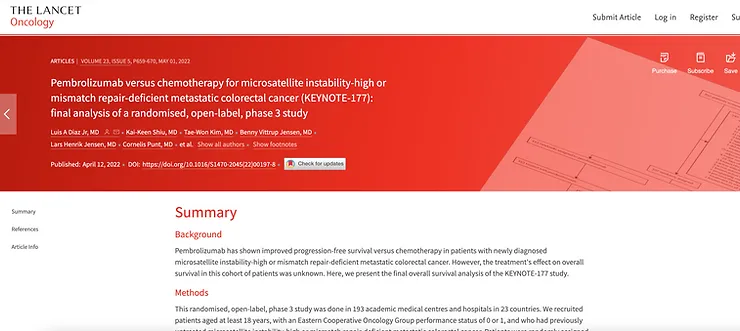 Figure 1
 Figure 2
 Figure 3
 Figure 4