
(Solid Tumors) Keytruda as Neoadjuvant Therapy in MSI-High/dMMR Unresectable and High-Risk Resectable Solid Tumors
Medical Supporter — Avis d’information
Cet article est une synthèse d’informations médicales internationales et ne constitue pas un avis médical ; il ne remplace pas le diagnostic ni le plan de traitement de votre médecin traitant. Les informations présentées sont compilées à partir de publications publiques et de déclarations officielles d’établissements médicaux japonais ; l’adéquation et les résultats de toute thérapie varient selon chaque patient et doivent être évalués individuellement par un médecin qualifié.
- October 6, 2021
- Read time: 1 minute
From September 16–21, 2021, Kaysia Ludford and colleagues from MD Anderson Cancer Center in Houston presented efficacy and safety results from a Phase II clinical trial evaluating Keytruda as neoadjuvant therapy in MSI-High/dMMR unresectable and high-risk resectable solid tumor patients, at the ESMO 2021 online conference in Europe.
This Phase II clinical trial enrolled MSI-High/dMMR unresectable and high-risk resectable solid tumor patients (N=35) treated with Keytruda 200 mg as neoadjuvant therapy in 3-week cycles for a total of 8 cycles. The primary endpoints were pathological complete response rate and safety; the secondary endpoint was objective response rate.
Tumor types in this trial included colorectal cancer (27 patients), and one patient each of endometrial cancer, gastric cancer, meningioma, duodenal cancer, papillary carcinoma, and pancreatic cancer.
Among 32 evaluable patients, the secondary endpoint objective response rate was 75%, comprising: complete response 25%, partial response 50%, stable disease 22%, and progressive disease 3%. Additionally, 15 patients underwent surgery following treatment, of whom 10 patients achieved pathological complete response. Regarding safety, Grade 3–4 adverse event incidence was 9% (N=3).
Based on Phase II clinical trial results, Kaysia Ludford and colleagues concluded: Keytruda as neoadjuvant therapy was well tolerated and demonstrated promising response rates in MSI-High/dMMR unresectable and high-risk resectable solid tumor patients. These patients should be further considered for surgery alternatives during treatment planning.
- Immunotherapy
- Clinical Trial Medications
Medical Supporter was formerly certified as an international medical visa guarantor by Japan's Ministry of Foreign Affairs and the Ministry of Economy, Trade and Industry (B-066).
Vous envisagez des soins au Japon ? Besoin d’informations et d’aide ?
Nous vous aidons à rassembler les informations nécessaires pour un déplacement médical au Japon, à contacter les établissements japonais et à organiser une consultation de second avis.La première consultation est gratuite ; un conseiller vous aide à clarifier les prochaines étapes.
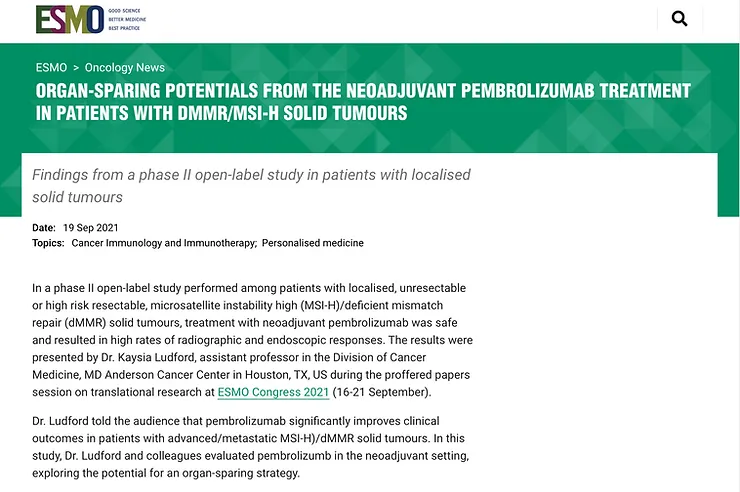 Figure 1
 Figure 2
 Figure 3
 Figure 4