
(Solid Tumors) Keytruda as Neoadjuvant Therapy in MSI-High/dMMR Unresectable and High-Risk Resectable Solid Tumors
Medical Supporter — Informationshinweis
Dieser Artikel ist eine Zusammenfassung internationaler medizinischer Informationen und stellt keine medizinische Beratung dar; er ersetzt nicht die Diagnose oder den Behandlungsplan Ihres behandelnden Arztes. Die dargestellten Informationen stammen aus öffentlichen Veröffentlichungen und offiziellen Angaben führender japanischer medizinischer Einrichtungen; Eignung und Wirkung einer Therapie sind individuell und müssen von einem qualifizierten Arzt beurteilt werden.
- October 6, 2021
- Read time: 1 minute
From September 16–21, 2021, Kaysia Ludford and colleagues from MD Anderson Cancer Center in Houston presented efficacy and safety results from a Phase II clinical trial evaluating Keytruda as neoadjuvant therapy in MSI-High/dMMR unresectable and high-risk resectable solid tumor patients, at the ESMO 2021 online conference in Europe.
This Phase II clinical trial enrolled MSI-High/dMMR unresectable and high-risk resectable solid tumor patients (N=35) treated with Keytruda 200 mg as neoadjuvant therapy in 3-week cycles for a total of 8 cycles. The primary endpoints were pathological complete response rate and safety; the secondary endpoint was objective response rate.
Tumor types in this trial included colorectal cancer (27 patients), and one patient each of endometrial cancer, gastric cancer, meningioma, duodenal cancer, papillary carcinoma, and pancreatic cancer.
Among 32 evaluable patients, the secondary endpoint objective response rate was 75%, comprising: complete response 25%, partial response 50%, stable disease 22%, and progressive disease 3%. Additionally, 15 patients underwent surgery following treatment, of whom 10 patients achieved pathological complete response. Regarding safety, Grade 3–4 adverse event incidence was 9% (N=3).
Based on Phase II clinical trial results, Kaysia Ludford and colleagues concluded: Keytruda as neoadjuvant therapy was well tolerated and demonstrated promising response rates in MSI-High/dMMR unresectable and high-risk resectable solid tumor patients. These patients should be further considered for surgery alternatives during treatment planning.
- Immunotherapy
- Clinical Trial Medications
Medical Supporter was formerly certified as an international medical visa guarantor by Japan's Ministry of Foreign Affairs and the Ministry of Economy, Trade and Industry (B-066).
Behandlung in Japan im Blick? Brauchen Sie Informationen und Unterstützung?
Wir helfen Ihnen, die für eine medizinische Reise nach Japan nötigen Informationen zu ordnen, kontaktieren japanische Einrichtungen und organisieren eine Zweitmeinungsberatung.Die Erstberatung ist kostenlos; ein Berater hilft Ihnen, die nächsten Schritte zu klären.
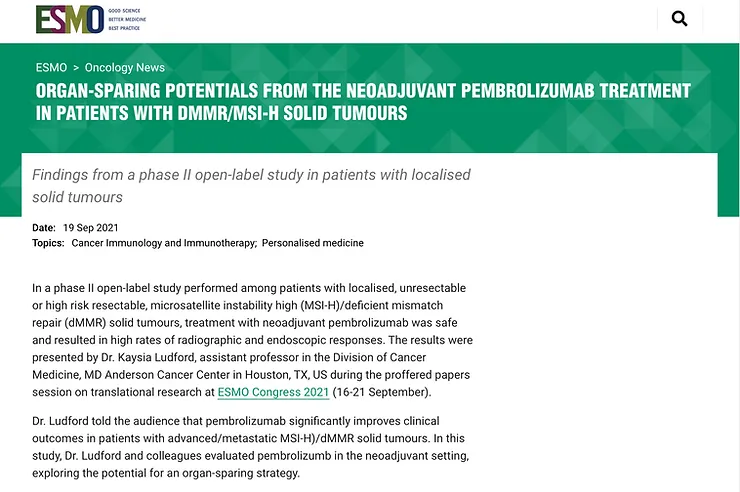 Figure 1
 Figure 2
 Figure 3
 Figure 4