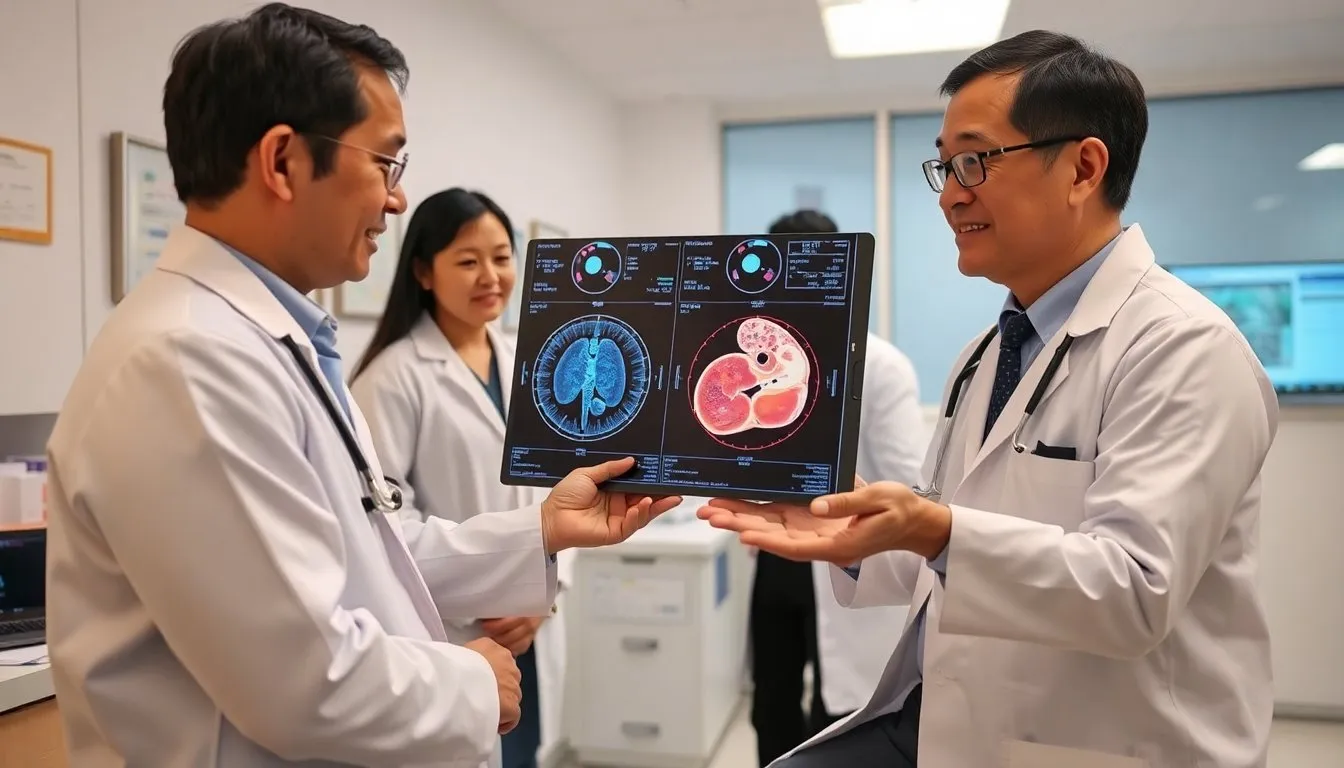
Cabozantinib + Tecentriq Effective for Liver Cancer?
Medical Supporter — Avis d’information
Cet article est une synthèse d’informations médicales internationales et ne constitue pas un avis médical ; il ne remplace pas le diagnostic ni le plan de traitement de votre médecin traitant. Les informations présentées sont compilées à partir de publications publiques et de déclarations officielles d’établissements médicaux japonais ; l’adéquation et les résultats de toute thérapie varient selon chaque patient et doivent être évalués individuellement par un médecin qualifié.
On July 4, 2022, R.K. Kelley and colleagues from the UCSF Helen Diller Family Comprehensive Cancer Center published the results of the COSMIC-312 Phase III clinical trial in the medical journal "The Lancet Oncology." The study evaluated the effectiveness and safety of Cabozantinib + Tecentriq as a first-line treatment for patients with advanced hepatocellular carcinoma (HCC).
COSMIC-312 was an open-label, multicenter Phase III trial that randomized 837 patients with advanced HCC in a 2:1:1 ratio into three groups: Cabozantinib (40mg once daily) + Tecentriq (1200mg every three weeks) (N=432), sorafenib (400mg twice daily) (N=217), and Cabozantinib monotherapy (60mg once daily) (N=188). The primary endpoints were progression-free survival (PFS) and overall survival (OS).
With a median follow-up of 15.8 months, the median progression-free survival was 6.8 months for the Cabozantinib + Tecentriq group versus 4.2 months for the sorafenib group. The median overall survival was 15.4 months for the Cabozantinib + Tecentriq group compared to 15.5 months for the sorafenib group.
Regarding safety, the incidence of Grade 3-4 side effects included: elevated ALT (Cabozantinib + Tecentriq 9%; sorafenib 3%; Cabozantinib 6%), hypertension (Cabozantinib + Tecentriq 9%; sorafenib 8%; Cabozantinib 12%), elevated AST (Cabozantinib + Tecentriq 9%; sorafenib 4%; Cabozantinib 10%), and hand-foot syndrome (Cabozantinib + Tecentriq 8%; sorafenib 8%; Cabozantinib 9%).
The incidence of serious side effects was 18% in the Cabozantinib + Tecentriq group, 8% in the sorafenib group, and 13% in the Cabozantinib group. Grade 5 adverse events occurred in 1% of patients in the combination group and in less than 1% of patients in both the sorafenib and Cabozantinib monotherapy groups.
Based on the results of the COSMIC-312 trial, R.K. Kelley and others stated that Cabozantinib + Tecentriq as a first-line treatment shows promise as a new therapeutic option for patients with advanced HCC, although additional trials are needed.
Sources: https://www.thelancet.com/journals/lanonc/article/PIIS1470-2045(22)00326-6/fulltext
Medical Supporter was formerly certified as an international medical visa guarantor by Japan's Ministry of Foreign Affairs and the Ministry of Economy, Trade and Industry (B-066).
Vous envisagez des soins au Japon ? Besoin d’informations et d’aide ?
Nous vous aidons à rassembler les informations nécessaires pour un déplacement médical au Japon, à contacter les établissements japonais et à organiser une consultation de second avis.La première consultation est gratuite ; un conseiller vous aide à clarifier les prochaines étapes.
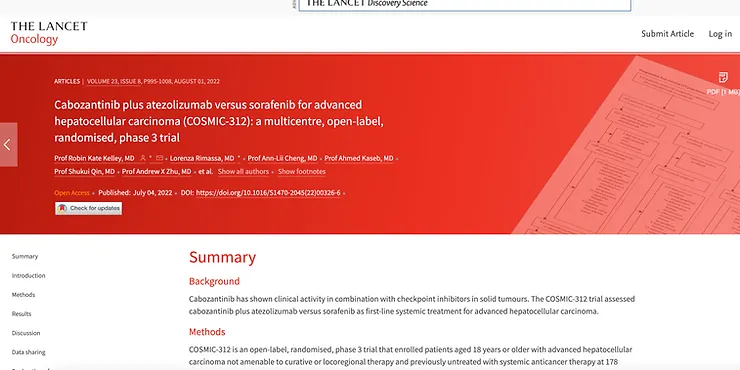 Figure 1
 Figure 2
 Figure 3
 Figure 4