يُعرض باللغة الإنجليزية — الترجمة العربية قيد الإعداد
blog
آخر تحديث: 2023-03-21

Mechanism Discovered: How Pancreatic Cancer Cells Disable Immune Cells

S
فريق Medical Supporter
فريق تنسيق طبي دولي ومراجعة تحريرية
Mechanism Discovered: How Pancreatic Cancer Cells Disable Immune Cells

Mechanism Discovered: How Pancreatic Cancer Cells Disable Immune Cells

Medical Supporter — إشعار معلوماتي

هذه المقالة ملخص لمعلومات طبية دولية وليست نصيحة طبية، ولا يمكن أن تحل محل تشخيص طبيبك المعالج أو خطة العلاج. المعلومات المعروضة مجمّعة من منشورات عامة وبيانات رسمية لكبرى المؤسسات الطبية اليابانية؛ وتختلف ملاءمة ونتائج أي علاج من مريض لآخر ويجب أن يقيّمها طبيب مؤهل لكل حالة على حدة.

يجب أن يقيّم أي خطة علاج محددة طبيب مرخّص في اليابان

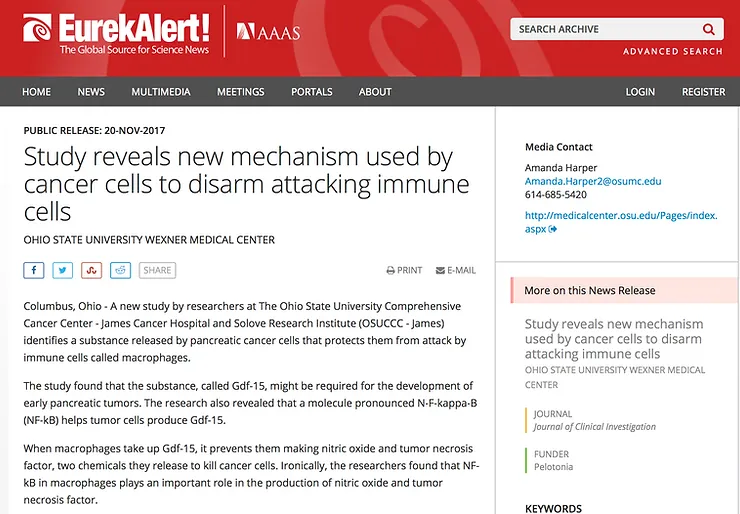
Macrophages are the body's first line of defense against cancer cells. Research has now revealed the substances secreted by pancreatic cancer cells that strip macrophages of their attack capability — shedding new light on the mechanism of cancer development.

Researchers at The Ohio State University Comprehensive Cancer Center (OSUCCC-James) identified substances in pancreatic cancer cells that protect them from macrophage attack.

The study identified GDF-15 — a substance essential for early pancreatic cancer formation — and the NF-kB molecule that promotes GDF-15 production.

When macrophages take up GDF-15, it inhibits the production of two key chemicals: nitric oxide and tumor necrosis factor. These are the same chemicals that macrophages normally secrete when they digest and destroy cancer cells.

The report was also published in the Journal of Clinical Investigation.

Lead researcher Dr. Denis Guttridge stated: "This study points to a significant relationship between pancreatic cancer development and GDF-15, and also links GDF-15 to the early formation of pancreatic cancer."

Dr. Guttridge, from the Molecular Carcinogenesis and Chemoprevention Program at OSUCCC-James, added: "By disabling macrophages, cancer cells are able to form in their early stages and survive as small tumors before gradually growing larger."

Using cells obtained from patient tumors and animal models, Dr. Guttridge and colleagues concluded:

NF-kB is a direct regulator of GDF-15, which suppresses macrophage activity by inhibiting the production of nitric oxide and tumor necrosis factor.

Dr. Guttridge further noted: "Taken together, our findings show that GDF-15 synthesis and secretion by pancreatic cancer cells is influenced by NF-kB. GDF-15 suppresses NF-kB activity in macrophages, preventing cancer cell death."

The OSUCCC-James research was funded by Pelotonia. Researchers included Nivedita M. Ratnam, Jennifer M. Peterson, Erin E. Talbert, Katherine J. Ladner, Priyani V. Rajasekera, Carl R. Schmidt, Mary E. Dillhoff, Benjamin J. Swanson, Ericka Haverick, Raleigh D. Kladney, Terence M. Williams and David J. Wang (The Ohio State University), and Gustavo W. Leone (University of South Carolina).

Source: https://eurekalert.org/pub_releases/2017-11/osuw-srn112017.php

Medical Supporter was formerly certified as an international medical visa guarantor by Japan's Ministry of Foreign Affairs and the Ministry of Economy, Trade and Industry (B-066).

هل تفكر في تلقّي العلاج في اليابان؟ هل تحتاج إلى معلومات ومساعدة؟

نساعدك في تنظيم المعلومات اللازمة للسفر الطبي إلى اليابان، والتواصل مع المؤسسات الطبية اليابانية، وترتيب استشارة رأي ثانٍ.الاستشارة الأولى مجانية؛ سيساعدك المستشار على توضيح الخطوات التالية.

المقر الرئيسي في فوكوكا: +81-92-409-5655
حاصل سابقًا على اعتماد رسمي، رقم B-066

Figure 1Figure 1

Figure 2Figure 2

Figure 3Figure 3

Figure 4Figure 4

Related Cancer Information

قراءة ذات صلة