blog
Last updated: 2019-12-28

Keytruda (Pembrolizumab) for Cervical Cancer

S
Medical Supporter Team
Cross-border medical coordination and editorial review team
Keytruda (Pembrolizumab) for Cervical Cancer

Keytruda (Pembrolizumab) for Cervical Cancer

Medical Supporter — Information Notice

This article is a summary of international medical information and is not medical advice; it cannot replace the diagnosis or treatment plan of your attending physician. The medical technologies, drug information and clinical data presented here are compiled from public literature and official statements of major Japanese medical institutions; the applicability and outcome of any therapy vary with each patient and must be assessed individually by a qualified physician.

Any specific treatment plan must be assessed by a licensed physician in Japan

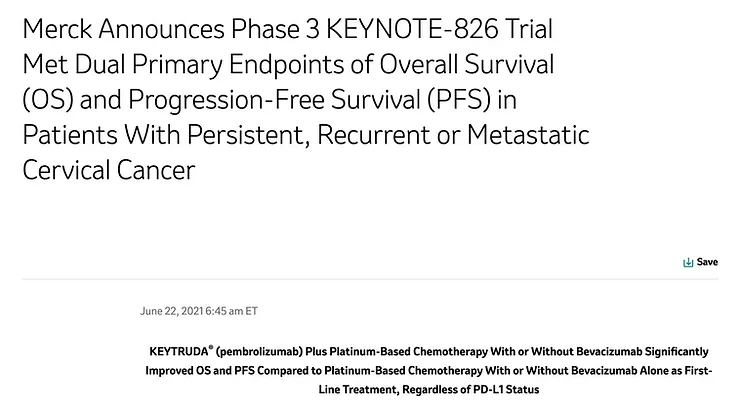
Keytruda (pembrolizumab) has been approved for the treatment of cervical cancer, including as a first-line treatment in combination with chemotherapy (with or without bevacizumab) for persistent, recurrent, or metastatic cervical cancer with PD-L1 expression (CPS ≥1), based on the KEYNOTE-826 trial results. Additionally, Keytruda is approved as second-line monotherapy for patients with PD-L1–positive (CPS ≥1) cervical cancer that progressed on or after chemotherapy. Medical Supporter provides information and coordination services for cervical cancer patients considering treatment at Japanese oncology centers.

Medical Supporter was formerly certified as an international medical visa guarantor by Japan's Ministry of Foreign Affairs and the Ministry of Economy, Trade and Industry (B-066).

Considering medical care in Japan? Need information and support?

We help you organize the information needed for medical travel to Japan, liaise with Japanese medical institutions, and arrange a second-opinion consultation.The first consultation is free; an advisor will help you clarify the next steps.

Fukuoka HQ: +81-92-409-5655
Formerly officially certified, No. B-066

Figure 1Figure 1

Figure 2Figure 2

Figure 3Figure 3

Figure 4Figure 4

Related Cancer Information

Related Reading