
(胸膜間皮瘤)Cediranib+Pemetrexed disodium+順鉑的有效性?
(胸膜間皮瘤)Cediranib+Pemetrexed disodium+順鉑的有效性?
Medical Supporter 資訊聲明
本文為國際醫療資訊整理,非醫療建議,無法取代主治醫師之診斷與治療方針。本站所載之醫療技術、藥物資訊與臨床數據,均編譯自日本各大醫療機關之公開文獻與官方說明;各項療法之適用性與成效受患者個人體質、病期與醫師診斷而異,須由合格醫師個別評估。
(胸膜間皮瘤)Cediranib+Pemetrexed disodium+順鉑的有效性?
- 2019年9月17日
- 讀畢需時 2 分鐘
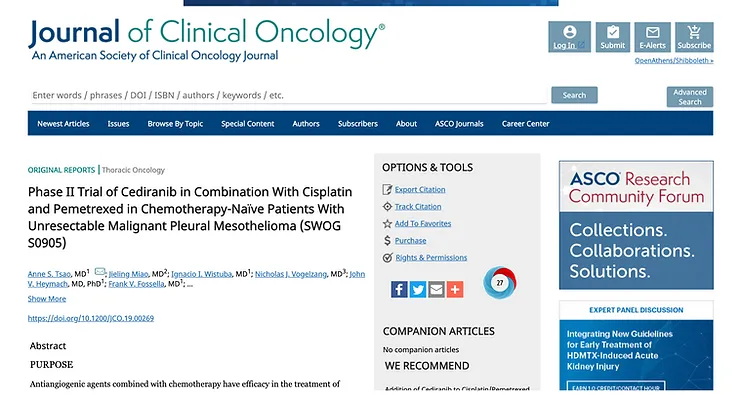
2019年8月6日、Anne S. Tsao在醫學雜誌『Journal of Clinical Oncology』上發表了『無法切除且未經化療的惡性胸膜間皮瘤患者,使用抗VEGF受體抑制劑Cediranib+Pemetrexed disodium+順鉑,在SWOG S0905第二期臨床試驗的有效性及安全性驗證。』
SWOG S0905試驗對無法切除且未經化療的惡性胸膜間皮瘤患者(N=92人)採隨機抽樣的第二期臨床試驗,主要評價項目為無惡化生存期間,次要評價項目為總生存期間、客觀反應率。
以21天為一個療程:
Cediranib組(第1天,Pemetrexed disodium500/m2+第1天,順鉑75mg/m2+第1~21天,每日一次,Cediranib20mg,N=45人)
安慰劑組(第1天,Pemetrexed disodium500/m2+第1天,順鉑75mg/m2+第1~21天,每日一次,安慰劑,N=47人)
本次試驗實施的背景為惡性胸膜間皮瘤屬於罕見癌種且預後不良,治療方式是相當有限。作為惡性胸膜間皮瘤屬的治療,使用全身化學治療預期可提升VEGF受體抑制劑的抗腫效果。根據以上背景因素,於本次試驗中檢證口服VEGF受體抑制劑Cediranib+化學治療的有效性。
本次試驗中患者的組成如下:
年齡中位數
Cediranib組:72歲(46-82歲)
安慰劑組:72歲(51-85歲)
性別
Cediranib組:男性84%
安慰劑組:男性85%
人種
Cediranib組:白人96%、非裔美國人2%
安慰劑組:白人89%、非裔美國人6%
日常體能狀態
Cediranib組:ECOG=0~1的有93%,ECOG=2的有27%
安慰劑組:ECOG=0~1的有94%,ECOG=2的有26%
有放射線治療經歷
Cediranib組:18%
安慰劑組:19%
有術前/術後化學治療經歷
Cediranib組:13%
安慰劑組:13%
根據以上的背景,在追訪期間中位數為31個月時的結果如下。主要評價項目無惡化生存期間中位數分別為:Cediranib組7.2個月/安慰劑組5.6個月,Cediranib組的疾病惡化風險改善29%,存活風險比為:0.71。
次要評價項目總生存期間中位數分別為:Cediranib組10個月/安慰劑組8.5個月,雖然Cediranib組的生存風險改善12%,但並沒有顯著的差異,存活風險比為:0.88。客觀的反應率分別為:Cediranib組50%/安慰劑組20%,Cediranib組50%明顯較高。
在安全性方面,總體副作用發生率分別為:Cediranib組100%/安慰劑組91%,等級3、4副作用發生率分別為:Cediranib組69%/安慰劑組57%。
Cediranib組與安慰劑組相比,Cediranib組的總體副作用發生率較高,其比率如下。食慾不振:51%/38%、腹瀉:46.7%/17%、流鼻血:13%/0%、肌肉萎縮:16%/9%、高血壓:44%/15%、噁心:76%/66%、末梢神經障礙:20%/11%、體重減少:36%/21%、骨髓抑制44%/30%。
根據SWOG S0905試驗的結果,Anne S. Tsao對此發表了以下結論:針對無法切除且未經化療的惡性胸膜間皮瘤患者,使用抗VEGF受體抑制劑Cediranib+Pemetrexed disodium+順鉑,無惡化生存期間及客觀反應率有所改善。
【注意事項】“醫療助手”所翻譯在海外進行的臨床試驗數據以及醫藥資訊,並非鼓吹諮詢臨床試驗以及各項新藥的使用。另外翻譯資料僅供各位參考,並非用藥準則,請和醫護人員討論以及正確內容以文章下方原文為主。
資料來源:Phase II Trial of Cediranib in Combination With Cisplatin and Pemetrexed in Chemotherapy-Naïve Patients With Unresectable Malignant Pleural Mesothelioma (SWOG S0905)(J Clin Oncol. 2019 Aug 6:JCO1900269. doi: 10.1200/JCO.19.00269.)
#胸膜間皮瘤
- 臨床實驗用藥
(肺癌)Topotecan及Topotecan+Berzosertib治療在第二期臨床試驗結果。 (肺癌)HER2基因變異非小細胞肺癌使用Enhertu有效? (肺癌)抗B7-H3抗體藥物DS-7300有效?
 圖片 1
圖片 1
 圖片 2
圖片 2
 圖片 3
圖片 3
 圖片 4
圖片 4