
Opdivo Poised to Become a Treatment for Gastric Cancer
Medical Supporter — Thông báo thông tin
Bài viết này là bản tổng hợp thông tin y tế quốc tế, không phải lời khuyên y tế và không thể thay thế chẩn đoán hay phác đồ điều trị của bác sĩ điều trị của bạn. Thông tin được biên soạn từ tài liệu công khai và công bố chính thức của các cơ sở y tế hàng đầu Nhật Bản; tính phù hợp và kết quả của mỗi liệu pháp khác nhau ở từng bệnh nhân và phải được bác sĩ có chuyên môn đánh giá riêng.
- February 3, 2017
- Reading time: 1 minute
In response to patient inquiries about recent cancer medication news, we have translated the ASCO 2017 report on Nivolumab (Opdivo), an anti-PD-1 antibody. This report discusses its use for unresectable or recurrent gastric cancer patients who are ineligible for conventional treatments, showing it can reduce the mortality rate by 37%. The final analysis of the double-blind, randomized Phase III clinical trial ONO-4538-12 was published. The results showed a significant improvement in overall survival (OS) in the Opdivo group compared to the placebo group, proving that this drug can become a viable third-line treatment option. The results were presented by Yoon-Koo Kang from the University of Ulsan College of Medicine, South Korea, at the Gastrointestinal Cancers Symposium held in San Francisco from January 19 to 21.
The ONO-4538-12 trial targeted patients with recurrent gastric cancer who were ineligible for standard therapy (Nivolumab 3mg/kg administered every two weeks) versus a placebo. This study involved 49 medical facilities across Japan, South Korea, and Taiwan. From November 2014 to February 2016, a total of 493 participants were enrolled: 330 in the Nivolumab group and 163 in the placebo group. Data collection concluded in August 2016. The patient characteristics were as follows: In the Nivolumab group, the median age was 62 (20–83), 57.3% were under 65, 69.4% were male, 46.1% were Japanese, 74.5% had metastasis in two or more organs, 20.9% had received two prior lines of therapy, 41.5% had three, and 37.6% had four or more. Prior treatments included 5-FU (99.7%), platinum-based drugs (94.2%), paclitaxel (86.1%), irinotecan (74.8%), and ramucirumab (10.6%).
In the placebo group, the median age was 61 (26–83), 58.3% were under 65, 73.0% were male, 73.0% had metastasis in two or more organs, 17.8% had received two lines of therapy, 38.0% had three, and 44.2% had four or more. Prior treatments included 5-FU (100%), platinum-based drugs (96.3%), paclitaxel (85.9%), irinotecan (75.5%), and ramucirumab (13.5%).
The median overall survival (OS) for the Nivolumab group was 5.32 months (95% CI: 4.63–6.41), compared to 4.14 months for the placebo group (95% CI: 3.42–4.86), p < 0.0001, indicating significantly better outcomes for the Nivolumab group. The 12-month OS rate was 26.6% for the Nivolumab group (95% CI: 21.1–32.4) and 10.9% for the placebo group (95% CI: 6.2–17.0). The 6-month OS was 46.4% for the Nivolumab group and 34.7% for the placebo group.
Clinical trial link: https://clinicaltrials.gov/show/NCT02267343
Source: Nivolumab (ONO-4538/BMS-936558) as salvage treatment after second or later-line chemotherapy for advanced gastric or gastro-esophageal junction cancer (AGC): A double-blinded, randomized, phase III trial. (Abstract No. 2)
Gastric Cancer
- Immunotherapy
- (Solid Tumors) Is Keytruda Effective?
- (Solid Tumors) Rakuten Medical Initiates Phase I Clinical Trial for RM-1995 Photo-immunotherapy
- (Lung Cancer) Is Keytruda Effective?
Medical Supporter Formerly certified by Japan's Ministry of Foreign Affairs and METI as an international medical visa guarantor (B-066).
Đang cân nhắc sang Nhật Bản điều trị? Cần thông tin và hỗ trợ?
Chúng tôi giúp bạn sắp xếp thông tin cần thiết để sang Nhật điều trị, liên hệ các cơ sở y tế Nhật Bản và sắp xếp tư vấn ý kiến thứ hai.Buổi tư vấn đầu tiên miễn phí; chuyên viên sẽ giúp bạn làm rõ các bước tiếp theo.
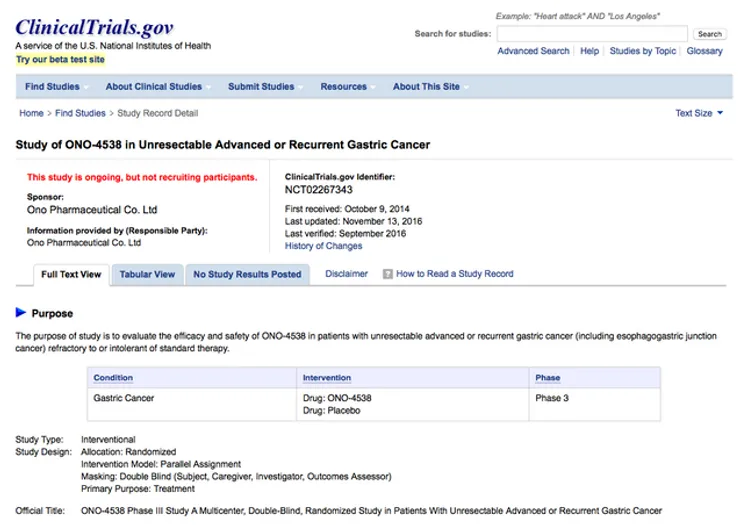 Figure 1
 Figure 2
 Figure 3
 Figure 4