
Opdivo Poised to Become a Treatment for Gastric Cancer
Medical Supporter — ประกาศข้อมูล
บทความนี้เป็นการสรุปข้อมูลทางการแพทย์ระหว่างประเทศ ไม่ใช่คำแนะนำทางการแพทย์ และไม่สามารถใช้แทนการวินิจฉัยหรือแผนการรักษาของแพทย์ผู้ดูแลของคุณได้ ข้อมูลที่นำเสนอรวบรวมจากเอกสารสาธารณะและคำชี้แจงอย่างเป็นทางการของสถาบันการแพทย์ชั้นนำของญี่ปุ่น ความเหมาะสมและผลของการรักษาแต่ละแบบแตกต่างกันไปในผู้ป่วยแต่ละราย และต้องได้รับการประเมินเป็นรายบุคคลโดยแพทย์ที่มีคุณสมบัติ
- February 3, 2017
- Reading time: 1 minute
In response to patient inquiries about recent cancer medication news, we have translated the ASCO 2017 report on Nivolumab (Opdivo), an anti-PD-1 antibody. This report discusses its use for unresectable or recurrent gastric cancer patients who are ineligible for conventional treatments, showing it can reduce the mortality rate by 37%. The final analysis of the double-blind, randomized Phase III clinical trial ONO-4538-12 was published. The results showed a significant improvement in overall survival (OS) in the Opdivo group compared to the placebo group, proving that this drug can become a viable third-line treatment option. The results were presented by Yoon-Koo Kang from the University of Ulsan College of Medicine, South Korea, at the Gastrointestinal Cancers Symposium held in San Francisco from January 19 to 21.
The ONO-4538-12 trial targeted patients with recurrent gastric cancer who were ineligible for standard therapy (Nivolumab 3mg/kg administered every two weeks) versus a placebo. This study involved 49 medical facilities across Japan, South Korea, and Taiwan. From November 2014 to February 2016, a total of 493 participants were enrolled: 330 in the Nivolumab group and 163 in the placebo group. Data collection concluded in August 2016. The patient characteristics were as follows: In the Nivolumab group, the median age was 62 (20–83), 57.3% were under 65, 69.4% were male, 46.1% were Japanese, 74.5% had metastasis in two or more organs, 20.9% had received two prior lines of therapy, 41.5% had three, and 37.6% had four or more. Prior treatments included 5-FU (99.7%), platinum-based drugs (94.2%), paclitaxel (86.1%), irinotecan (74.8%), and ramucirumab (10.6%).
In the placebo group, the median age was 61 (26–83), 58.3% were under 65, 73.0% were male, 73.0% had metastasis in two or more organs, 17.8% had received two lines of therapy, 38.0% had three, and 44.2% had four or more. Prior treatments included 5-FU (100%), platinum-based drugs (96.3%), paclitaxel (85.9%), irinotecan (75.5%), and ramucirumab (13.5%).
The median overall survival (OS) for the Nivolumab group was 5.32 months (95% CI: 4.63–6.41), compared to 4.14 months for the placebo group (95% CI: 3.42–4.86), p < 0.0001, indicating significantly better outcomes for the Nivolumab group. The 12-month OS rate was 26.6% for the Nivolumab group (95% CI: 21.1–32.4) and 10.9% for the placebo group (95% CI: 6.2–17.0). The 6-month OS was 46.4% for the Nivolumab group and 34.7% for the placebo group.
Clinical trial link: https://clinicaltrials.gov/show/NCT02267343
Source: Nivolumab (ONO-4538/BMS-936558) as salvage treatment after second or later-line chemotherapy for advanced gastric or gastro-esophageal junction cancer (AGC): A double-blinded, randomized, phase III trial. (Abstract No. 2)
Gastric Cancer
- Immunotherapy
- (Solid Tumors) Is Keytruda Effective?
- (Solid Tumors) Rakuten Medical Initiates Phase I Clinical Trial for RM-1995 Photo-immunotherapy
- (Lung Cancer) Is Keytruda Effective?
Medical Supporter Formerly certified by Japan's Ministry of Foreign Affairs and METI as an international medical visa guarantor (B-066).
กำลังพิจารณาเดินทางไปรักษาที่ญี่ปุ่น? ต้องการข้อมูลและความช่วยเหลือไหม?
เราช่วยคุณจัดเตรียมข้อมูลที่จำเป็นสำหรับการเดินทางไปรักษาที่ญี่ปุ่น ติดต่อสถาบันการแพทย์ญี่ปุ่น และจัดการปรึกษาความเห็นที่สองการปรึกษาครั้งแรกฟรี ที่ปรึกษาจะช่วยให้คุณเห็นขั้นตอนต่อไปชัดเจน
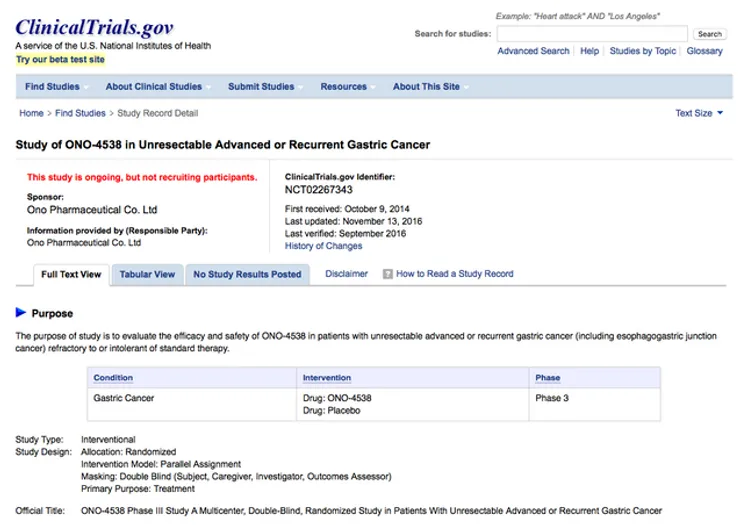 Figure 1
 Figure 2
 Figure 3
 Figure 4