Unresectable Hepatocellular Carcinoma: Dual Immune Checkpoint Blockade with STRIDE Regimen
Medical Supporter — Avis d’information
Cet article est une synthèse d’informations médicales internationales et ne constitue pas un avis médical ; il ne remplace pas le diagnostic ni le plan de traitement de votre médecin traitant. Les informations présentées sont compilées à partir de publications publiques et de déclarations officielles d’établissements médicaux japonais ; l’adéquation et les résultats de toute thérapie varient selon chaque patient et doivent être évalués individuellement par un médecin qualifié.
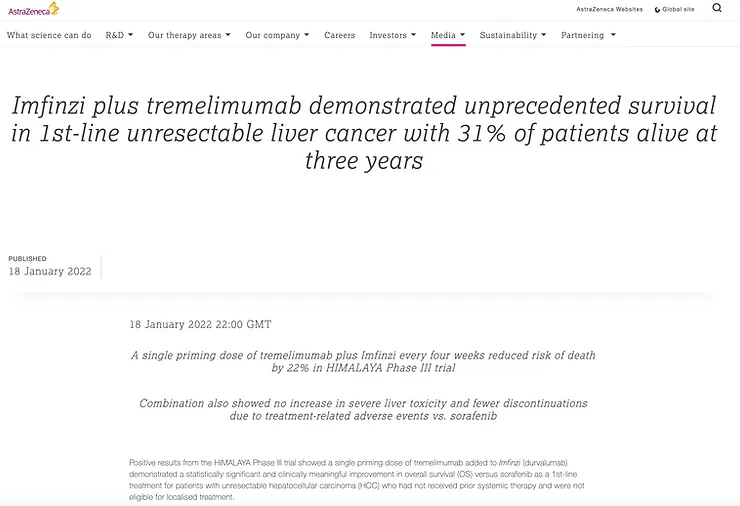
HIMALAYA Phase III Trial: Unprecedented Survival Benefit
- January 18, 2022
- Reading time: 2 minutes
On January 18, 2022, AstraZeneca announced results from the HIMALAYA Phase III randomized clinical trial evaluating the efficacy and safety of combined immune checkpoint blockade as first-line treatment for unresectable hepatocellular carcinoma patients ineligible for locoregional therapy.
Trial Design and Treatment Arms
HIMALAYA was an international, multi-institutional, randomized Phase III open-label study enrolling 1,171 treatment-naive patients with unresectable hepatocellular carcinoma ineligible for locoregional therapy, randomized into three arms:
Arm 1 - Imfinzi (Durvalumab) Monotherapy:
- Durvalumab 1,500 mg IV every 4 weeks
- N=389 patients
Arm 2 - STRIDE Regimen (Durvalumab Plus Tremelimumab):
- Durvalumab 1,500 mg IV plus Tremelimumab 300 mg IV on Day 1
- Followed by durvalumab monotherapy continuing every 4 weeks
- N=393 patients
Arm 3 - Sorafenib Control:
- Sorafenib tyrosine kinase inhibitor
- N=389 patients
Primary endpoint: overall survival comparing STRIDE vs Sorafenib
Secondary endpoints: overall survival across all groups, objective response rate, progression-free survival
Primary Efficacy Results
Overall Survival - STRIDE vs Sorafenib:
- STRIDE group: 16.4 months median
- Sorafenib group: 13.8 months median
- 22% reduction in mortality risk with STRIDE regimen
2-Year Overall Survival Rates:
- STRIDE: 40.5%
- Durvalumab monotherapy: 39.6%
- Sorafenib: 32.6%
3-Year Overall Survival Rates:
- STRIDE: 30.7%
- Durvalumab monotherapy: 24.7%
- Sorafenib: 20.2%
Secondary Efficacy Outcomes
Objective Response Rate:
- STRIDE: 20.1%
- Durvalumab monotherapy: 17.0%
- Sorafenib: 5.1%
Median Duration of Response:
- STRIDE: 22.3 months
- Durvalumab monotherapy: 16.8 months
- Sorafenib: 18.4 months
Safety and Tolerability
Grade 3-4 Adverse Events:
- STRIDE: 25.8%
- Durvalumab monotherapy: 12.9%
- Sorafenib: 36.9%
Hepatology-Related Adverse Events:
- STRIDE: 5.9%
- Durvalumab monotherapy: 5.2%
- Sorafenib: 4.5%
Treatment Discontinuation Due to Adverse Events:
- STRIDE: 8.2%
- Durvalumab monotherapy: 4.1%
- Sorafenib: 11%
Safety profiles of STRIDE and durvalumab monotherapy were consistent with prior clinical experience. No novel unexpected adverse events were identified.
Clinical Conclusions
According to Ghassan Abou-Alfa, MD, principal investigator from Memorial Sloan Kettering Cancer Center:
"Treatment-naive, unresectable hepatocellular carcinoma patients ineligible for locoregional therapy have historically demonstrated poor prognosis, necessitating novel therapeutic approaches. The HIMALAYA trial demonstrates that STRIDE combination immunotherapy delivers substantially improved 3-year overall survival rates with a favorable safety profile compared to sorafenib. These results support STRIDE as a potential new first-line treatment paradigm for this patient population with otherwise limited therapeutic options."
Data Source
Related Hepatocellular Carcinoma Treatment Options
- Immunotherapy
- Clinical Trial Therapeutics
- (Lung Cancer) Topotecan and Topotecan Plus Berzosertib Phase II Trial Results
- (Lung Cancer) HER2-Mutant Non-Small Cell Lung Cancer Treatment with Enhertu
- (Lung Cancer) Anti-B7-H3 Antibody DS-7300 Clinical Efficacy
Medical Supporter was formerly certified as an international medical visa guarantor by Japan's Ministry of Foreign Affairs and the Ministry of Economy, Trade and Industry (B-066).
Vous envisagez des soins au Japon ? Besoin d’informations et d’aide ?
Nous vous aidons à rassembler les informations nécessaires pour un déplacement médical au Japon, à contacter les établissements japonais et à organiser une consultation de second avis.La première consultation est gratuite ; un conseiller vous aide à clarifier les prochaines étapes.
Figure 1
Figure 2
Figure 3
Figure 4