
FDA Grants Accelerated Approval to Infigratinib for Metastatic Cholangiocarcinoma
Medical Supporter — Avis d’information
Cet article est une synthèse d’informations médicales internationales et ne constitue pas un avis médical ; il ne remplace pas le diagnostic ni le plan de traitement de votre médecin traitant. Les informations présentées sont compilées à partir de publications publiques et de déclarations officielles d’établissements médicaux japonais ; l’adéquation et les résultats de toute thérapie varient selon chaque patient et doivent être évalués individuellement par un médecin qualifié.
On May 28, 2021, the U.S. Food and Drug Administration (FDA) granted accelerated approval to Infigratinib (Truseltiq) for adult patients with previously treated, unresectable locally advanced or metastatic cholangiocarcinoma (bile duct cancer) harboring a FGFR2 fusion or other rearrangement as detected by an FDA-approved test.
Clinical Evidence: Study CBGJ398X2204
The approval was based on results from Study CBGJ398X2204 (NCT02150967), a multicenter, open-label, single-arm trial involving 108 patients with FGFR2 fusion-positive cholangiocarcinoma who had failed at least one prior line of systemic therapy.
Patients received 125 mg of Infigratinib orally once daily for 21 consecutive days, followed by 7 days off, in 28-day cycles.
Key Efficacy Results
- Objective Response Rate (ORR): 23%
- Complete Response (CR): 1 patient
- Partial Response (PR): 24 patients
- Median Duration of Response (DOR): 5 months
- Eight of the 25 responders (32%) maintained a response for 6 months or longer.
Safety and Side Effects
The most common adverse reactions (incidence ≥ 20%) included hyperphosphatemia, increased creatinine, nail disorders, stomatitis, dry eye, fatigue, alopecia, palmar-plantar erythrodysesthesia syndrome, arthralgia, dysgeusia, constipation, abdominal pain, dry mouth, diarrhea, dry skin, decreased appetite, blurred vision, and vomiting.
Important Safety Monitoring: Serious adverse events included hyperphosphatemia and retinal pigment epithelial detachment (RPED). Regular monitoring of phosphate levels and ophthalmic examinations are recommended during treatment.
Dosage and Administration
The recommended dose is 125 mg orally once daily for 21 days, followed by 7 days off, in 28-day cycles. Treatment should continue until disease progression or unacceptable toxicity.
Source: FDA - Accelerated Approval of Infigratinib for Cholangiocarcinoma
#BiliaryTractCancer #Cholangiocarcinoma #Infigratinib #Truseltiq #FGFR2 #FDAApproval #CancerTreatment
Vous envisagez des soins au Japon ? Besoin d’informations et d’aide ?
Nous vous aidons à rassembler les informations nécessaires pour un déplacement médical au Japon, à contacter les établissements japonais et à organiser une consultation de second avis.La première consultation est gratuite ; un conseiller vous aide à clarifier les prochaines étapes.
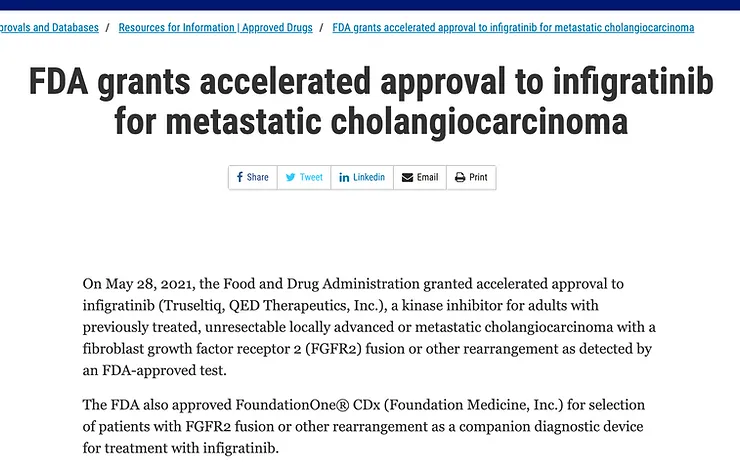 Figure 1
 Figure 2
 Figure 3
 Figure 4